


The Greeks had two words for power.
Hegemonia: leadership earned by bearing the cost.
Arkhe: control imposed by force.
The distance between them is measured in how allies behave when the bill arrives.
Globalism is dead.
Not dying and in need of a blood transfusion. Already passed, we just haven’t booked the funeral.
The irony, which may take a generation to metabolize, is that the very things the world attacked America for, the military bases, the aircraft carriers parked next door, the nuclear umbrella, the arrogance of thinking it was our job to police the sea lanes, the dominance of the dollar and the financial system behind it, were the very things that made globalism work.
Free markets. Free movement of goods. The promise that you didn’t need to be a nationalist or a mercantilist to guarantee your economic security. That if you played by the rules, the pie would grow and everyone would eat. That promise had a name. Pax Americana. Hegemonia.
And it had a price. Paid by American taxes and American blood, decade after decade, while the beneficiaries griped about the bill. Korea, thirty-six thousand dead, no colonies acquired. Vietnam, fifty-eight thousand dead, both countries now doing more trade with China than they ever did with us. The Marshall Plan. The nuclear umbrella. A hundred thousand troops across nineteen European countries, a navy burning through carrier strike groups at $25 million a day so that German cars and French wine could reach global markets without a European frigate in sight.
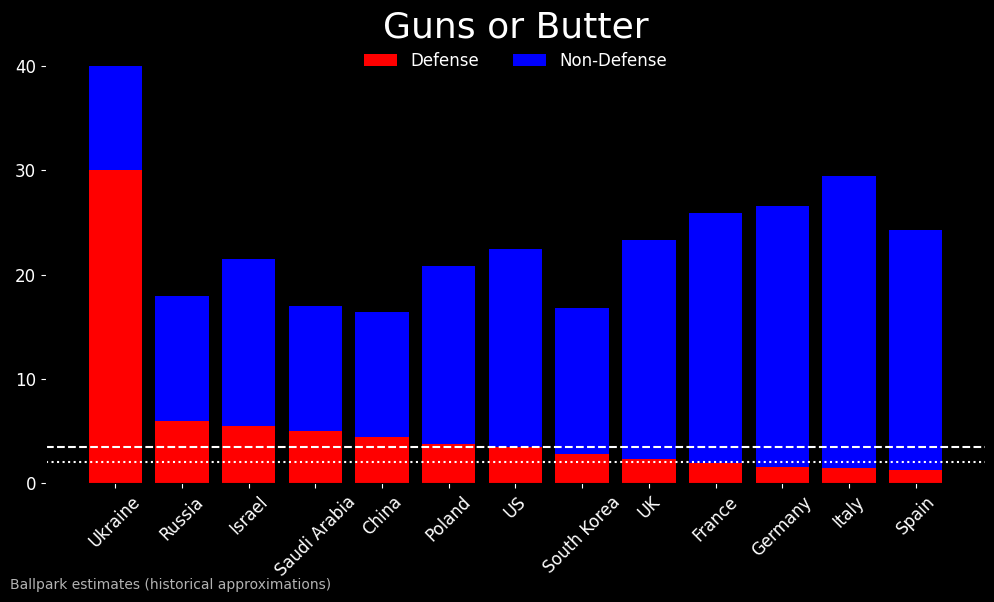
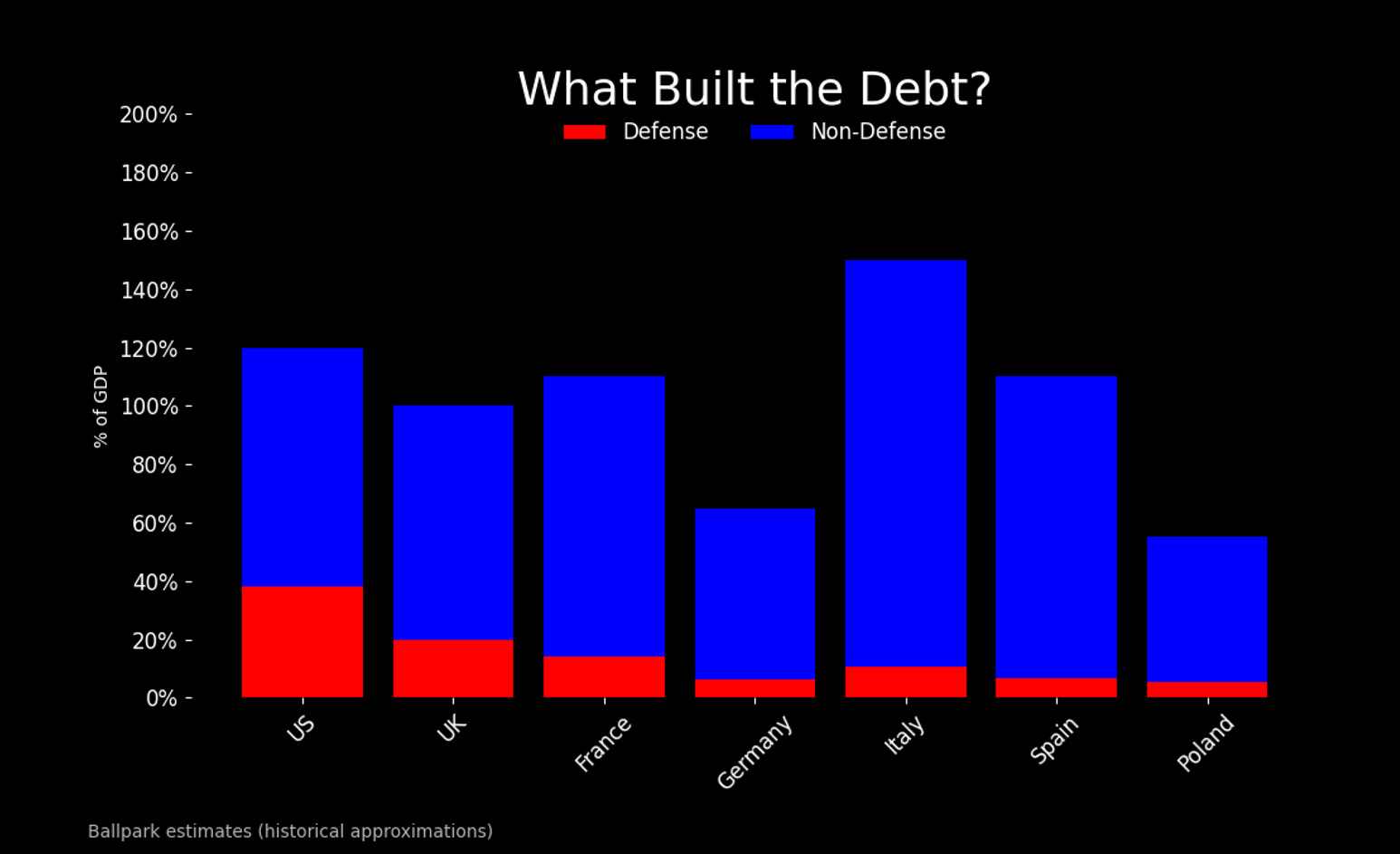
Our adversaries frame this as empire. The track record says duty. Find me another power in history that won a war and then rebuilt its enemies into functioning democracies. We did it twice. That’s not arkhe. That’s hegemonia at cost.
Now the conflict in Iran has brought a new breaking point. And France, looking at the latest receipts, has said, along with much of Europe: return to sender. Blocked the resolution. Cut a side deal with Iran for transit. Started organizing a bloc. This is the story of what that means, and where it leads. Because where it leads is not where anyone cheering thinks it does.
This week, France joined Russia and China in blocking a UN Security Council resolution that would have authorized force to reopen the Strait of Hormuz. The draft has been revised, watered down, delayed, and is now pushed to next week with no date set. The body designed to enforce international order can’t even schedule a vote.
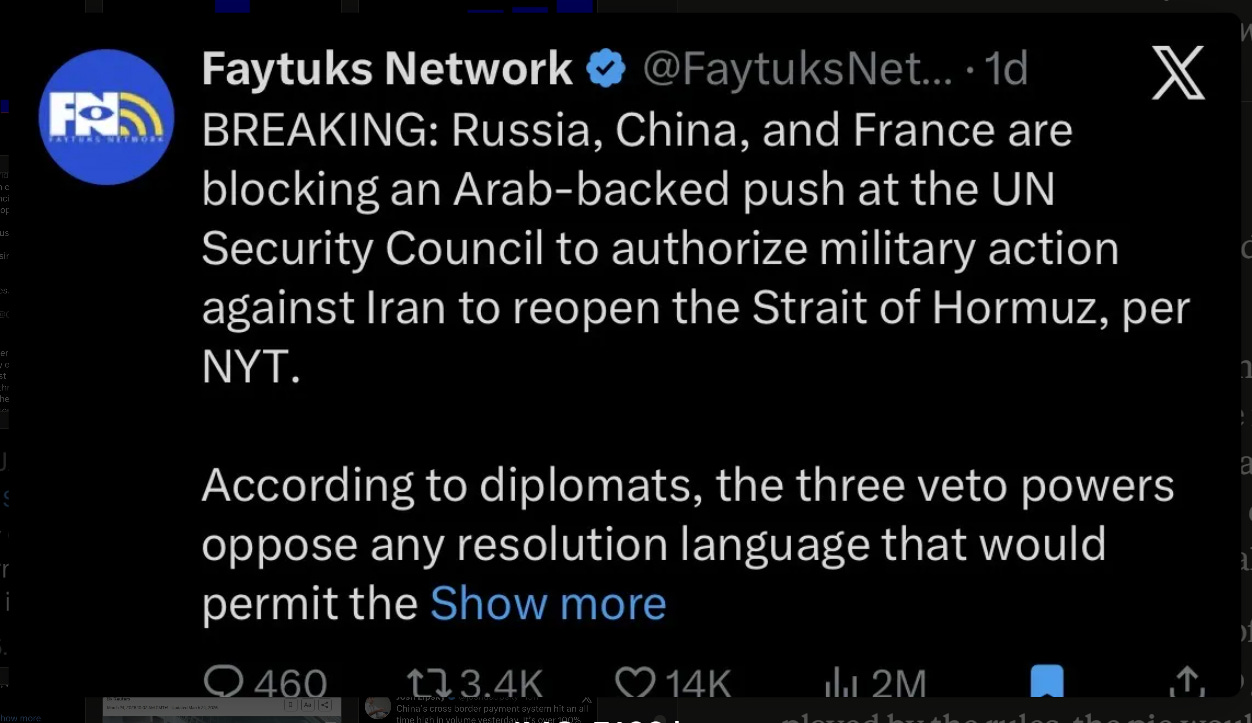
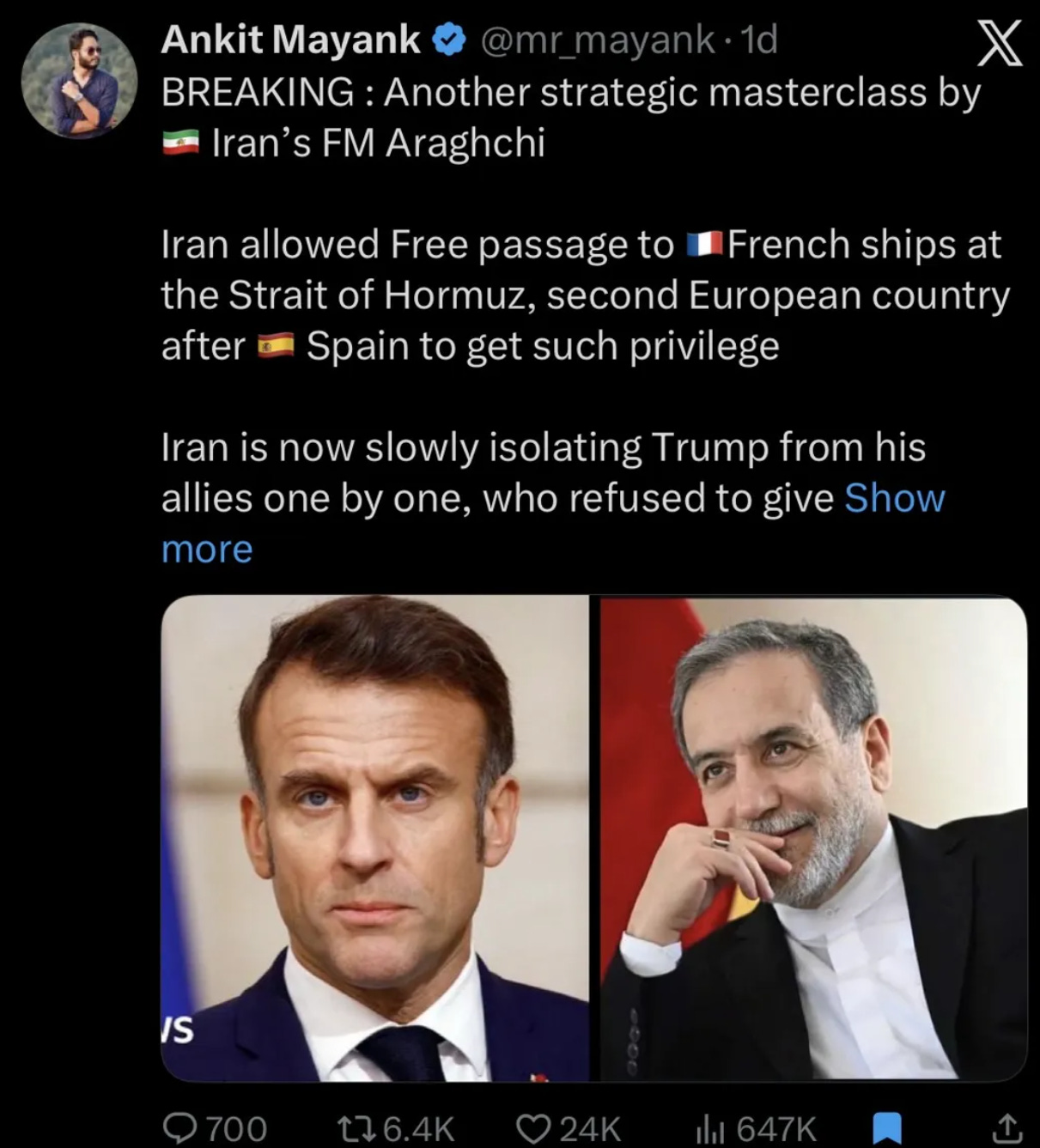
Meanwhile, a French container ship, the CMA CGM Kribi, transited the Strait on April 2. Malta-flagged but broadcasting “Owner France” on its AIS transponder, it followed an Iran-approved corridor hugging the coastline between Qeshm and Larak islands. The first Western-linked vessel granted passage since the closure.
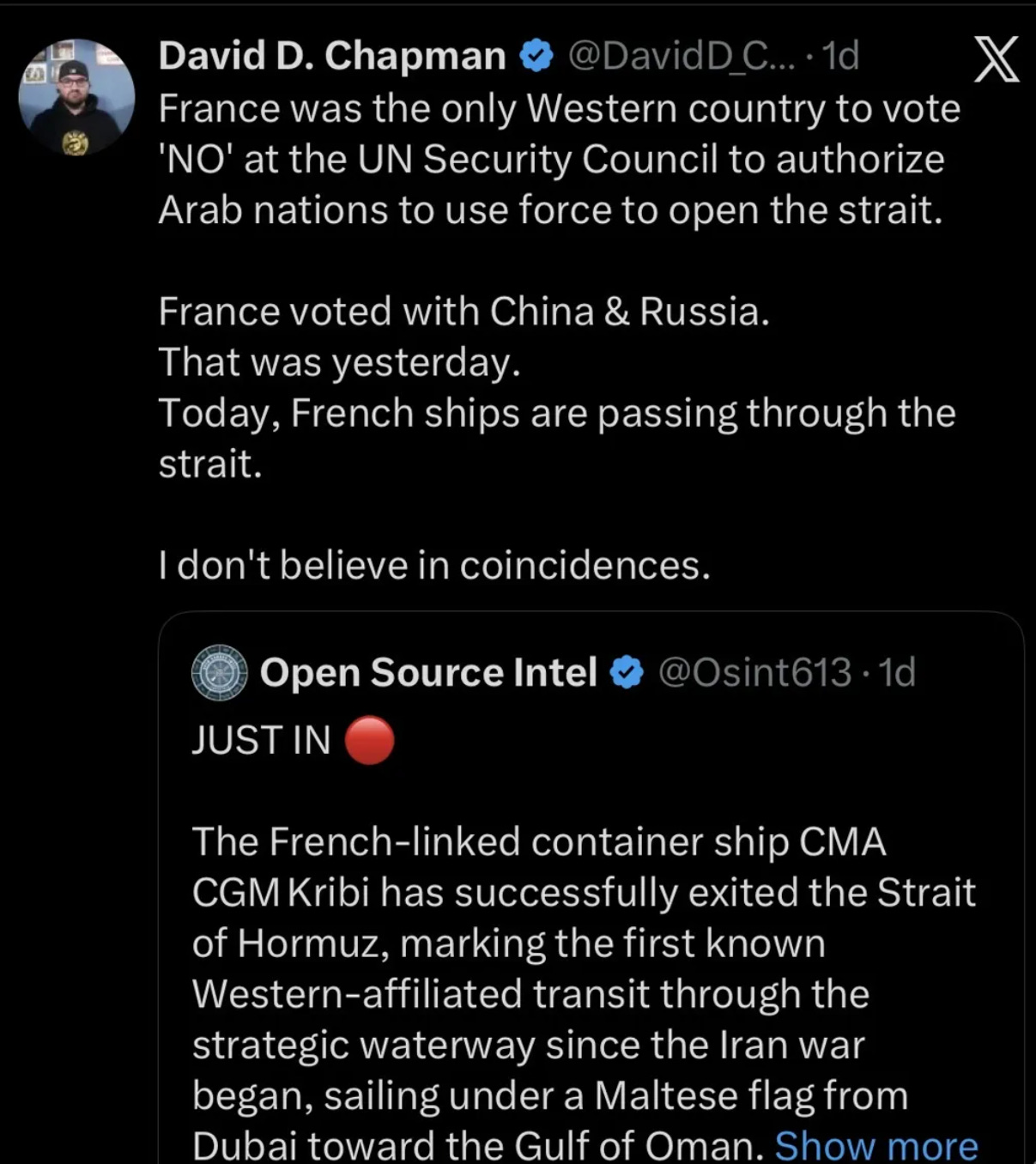
Then Macron restricted French airspace for US military overflights. Austria followed suit. And the president of France called for a “coalition of independents” from the United States and China.
While American sailors are in the Gulf. While American soldiers sit in Berlin, facing Moscow, as they have for a generation. As American might props up the Ukrainian bulwark against a very different kind of would-be hegemon.
For those paying attention, this defection is not a surprise. It’s the latest in a long series fueled by a combination of well-meaning disagreement, self-interest, and yes, mutual ego.
The UK blocked basing rights at Diego Garcia and Fairford, then signed away sovereignty of the Chagos Islands to a country with a Chinese free trade agreement, as China plans a base next door. Italy denied landing rights at Sigonella. Germany said Hormuz “has nothing to do with NATO.” Spain called the war “illegal and immoral.” The EU fined Apple, Meta, and Google billions while pumping €3.06 billion in FDI into China in a single quarter.
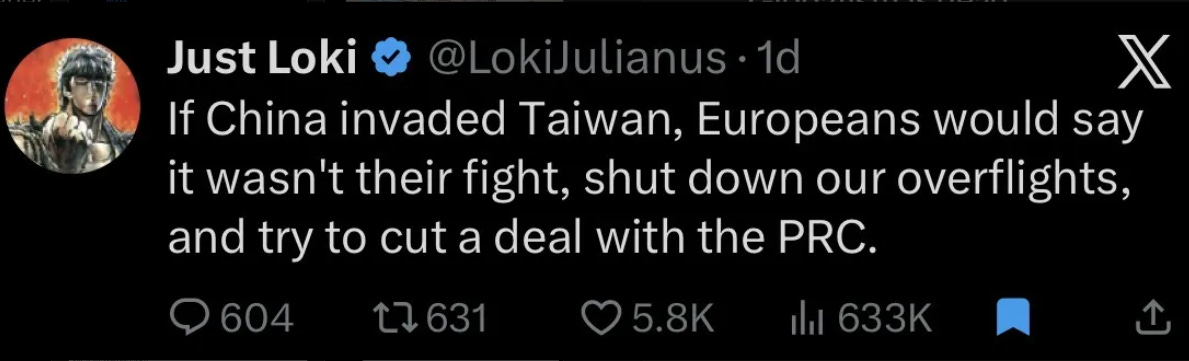
The message, uniform across the Union: this is not our fight.
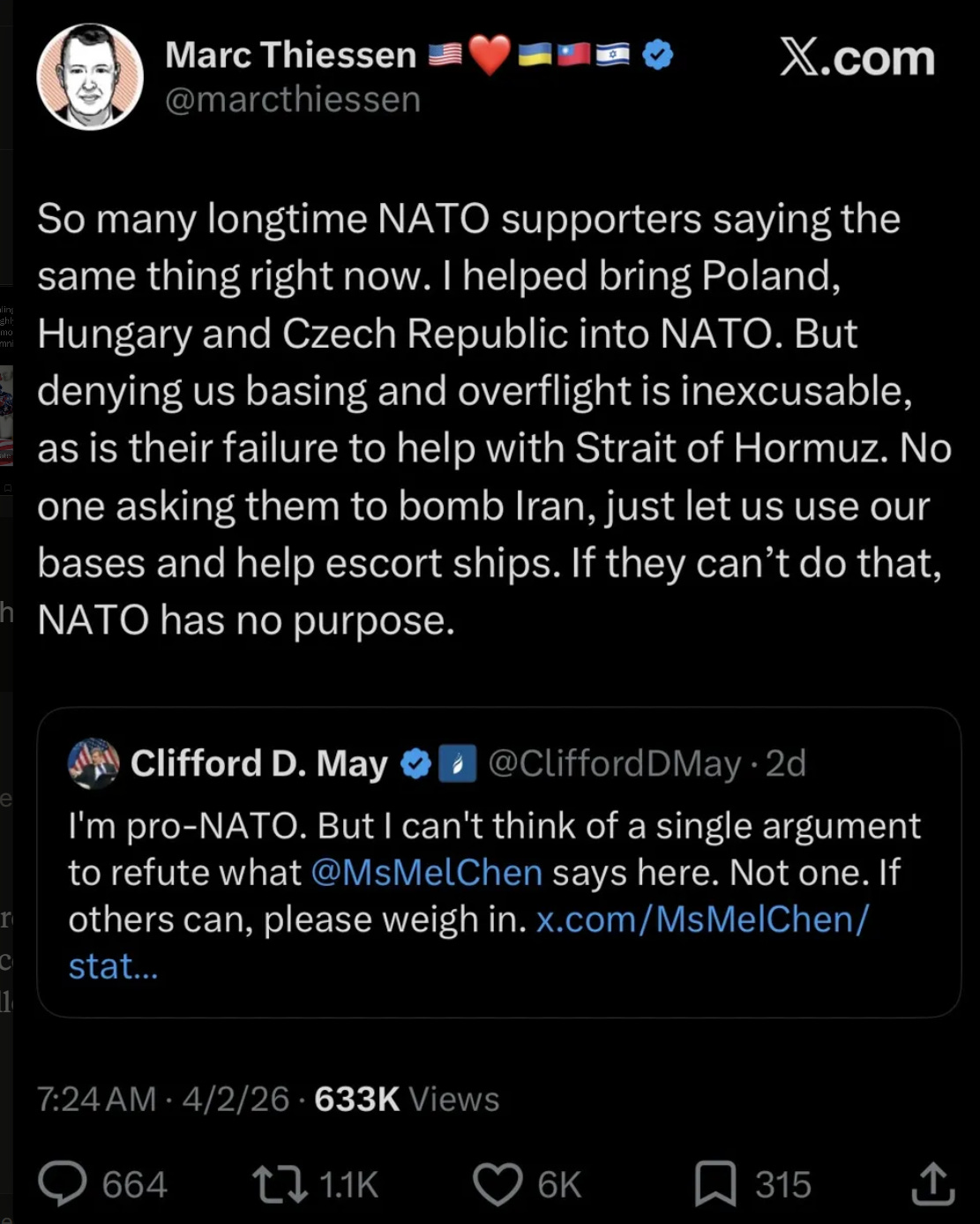
Which is totally fair. Until you do the accounting of where the sea lanes that brought Europe its energy came from, and which partner covers their eastern flank. Europe can opt out of Taiwan. They can opt out of Hormuz. They cannot opt out of Poland. And depending on where we are going, these may all be the same thing.
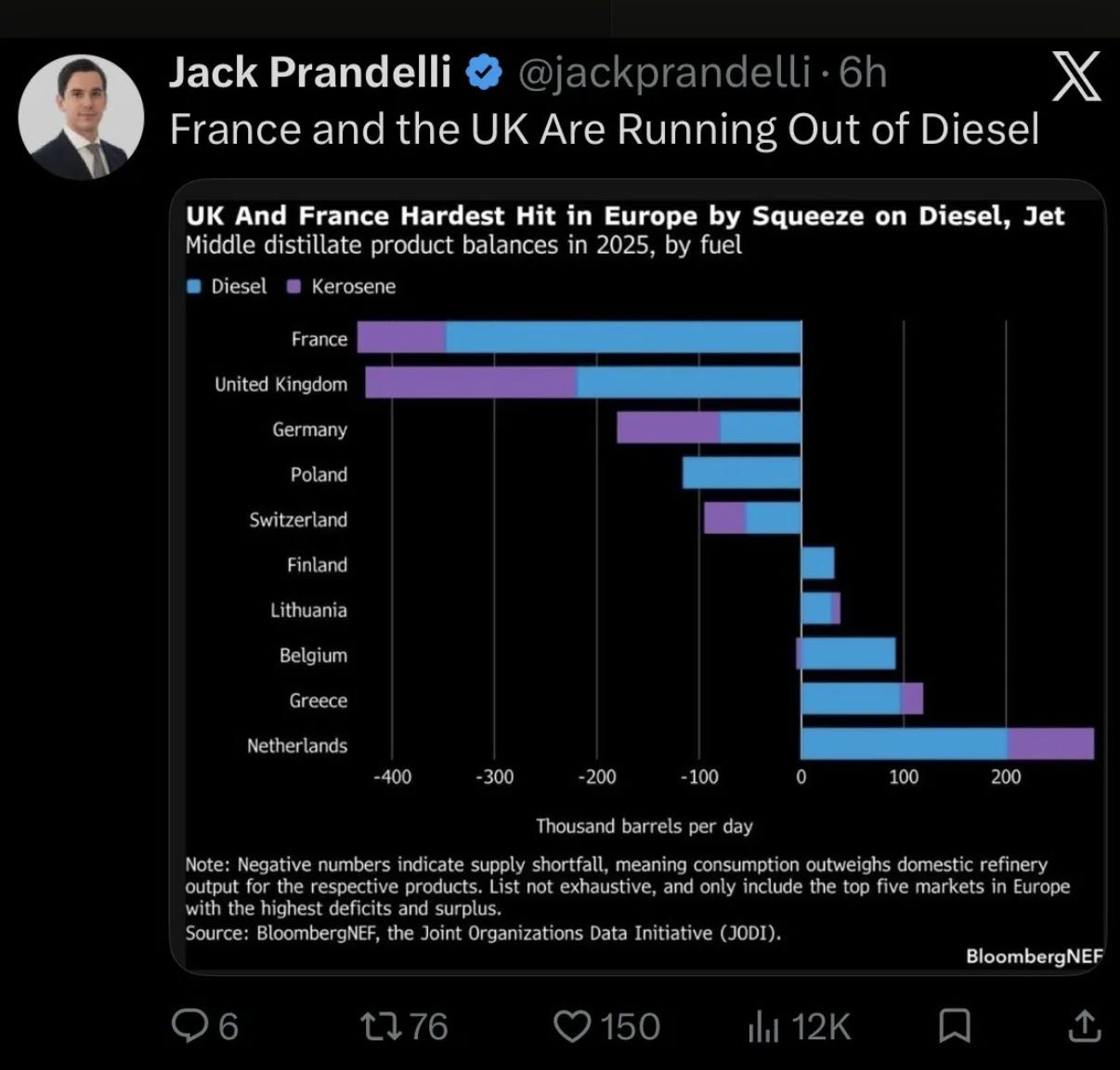
Game theory has a concept called a separating equilibrium. When the hegemon subsidizes everyone equally, partners and free riders look identical. Nobody has to show their cards. The moment you introduce an actual cost, a tariff, a demand, a Greenland, the types separate. Real partners pay and stay. Free riders defect.
Europe just revealed its type.
The problem is that, when you do the backward induction of where we’re going, they may not have a choice.
The point of this piece isn’t to compile grievances. I have lived in Europe. I love Europe. I feel a tremendous affinity for European people, European culture, and European history. America is, ultimately, a colony of Europe. The point is what the defection tells you about where we are and where we are going.
The post-Cold War bet was straightforward. The West won. The Soviet Union collapsed. And the wager, the big, optimistic, historically unprecedented wager, was that the defeated powers and the rising powers would integrate. Russia would become a market economy with rule of law. China would gain entrance to the concert of nations and inevitably liberalize as its middle class grew. The globalist order would absorb them, the way it absorbed Germany and Japan after 1945, and the arc of history would do what arcs are supposed to do. The pie would grow.
The only problem is that, as they say, the other guys get a vote. And rather than submit to a global order with the US at its beating center, they saw a path to a “New Era” with a new Heartland alliance at its center. All that was needed was to build up sufficient strength over time, chip away at the alliance structure, and hollow out the globalist hegemony from the inside.
Russia co-opted Europe through gas. Schröder, Merkel, Nord Stream. Germany traded energy sovereignty for green credibility and Russian supply, and the dependency gave Moscow a lever it pulled the moment Ukraine became inconvenient. That wasn’t an accident. It was the plan working.
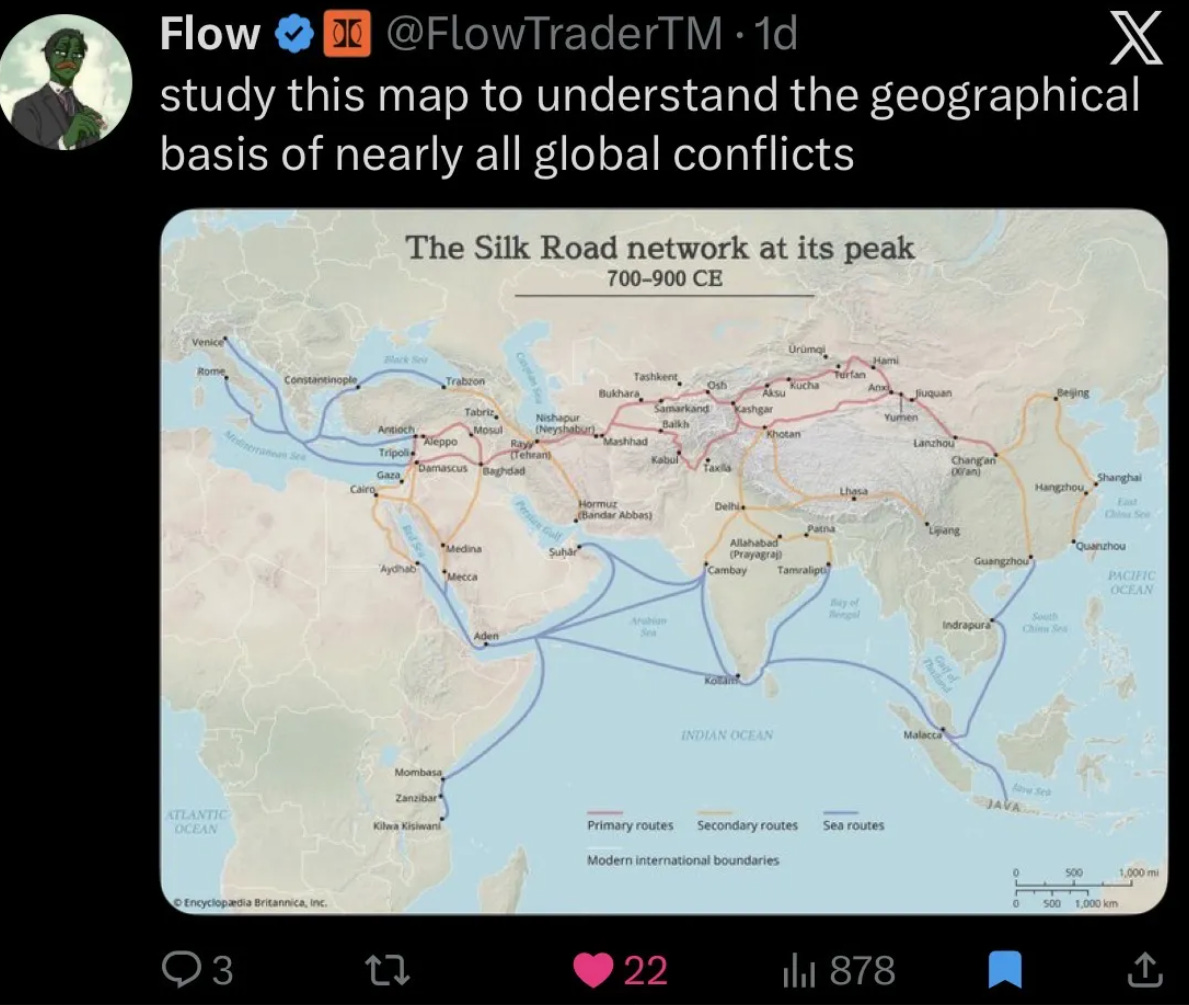
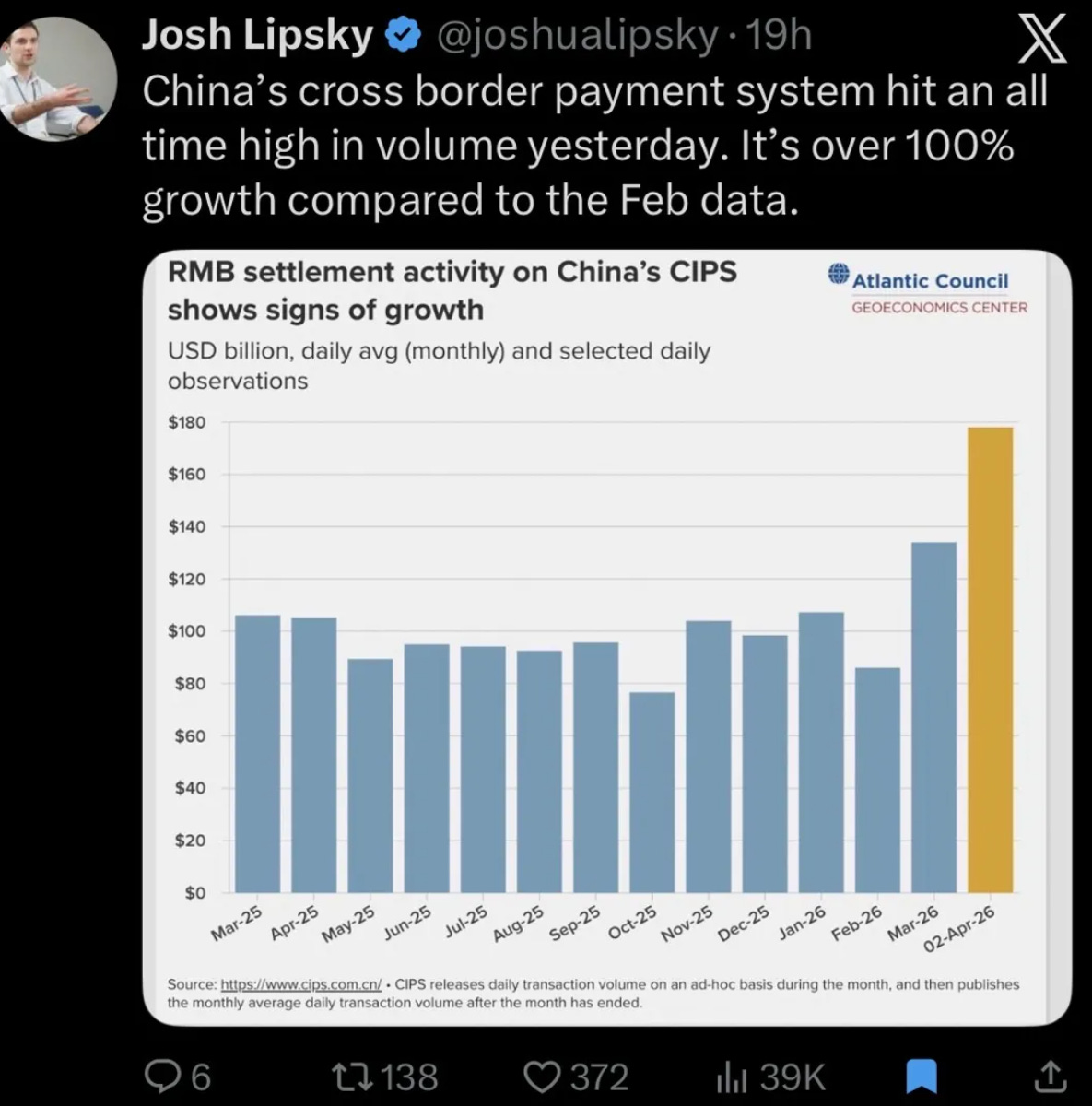
China hollowed out American manufacturing through the greatest mercantilist project in history. Subsidized production, currency management, IP theft at industrial scale, and a domestic market that was always “about to open” and never did. Hong Kong as a gateway to turn dollars into factories. Burn more coal in a year than Europe has cut in a decade. Build the Belt and Road. Expand BRICS payment rails. Talk about de-dollarization while free-riding on the dollar-based export machine.
And Iran, with Russian and Chinese backing, went for the nuclear threshold.
Three pillars of the globalist order attacked: European energy, American manufacturing, Gulf security. All aimed at the same target: the capacity of the United States to sustain hegemonia.
And then, inevitably, they found each other.
Iran’s nuclear program was never just about Iran. It was an existential threat to the entire architecture underneath globalism. The US guaranteed security for every Gulf state. Saudi Arabia, the UAE, Kuwait, Bahrain, Qatar. The deal was the same as Europe’s: we provide the umbrella, you provide the oil, nobody needs nukes. The NPT held because the hegemon’s guarantee made it rational not to proliferate.
Iran getting a weapon breaks that logic for every country within missile range. Saudi runs the numbers. Turkey runs the numbers. Egypt runs the numbers. The most volatile region on earth becomes a multi-nuclear powder keg.
That’s why we’re at war. Not oil. Not regime change. The nuclear threshold.
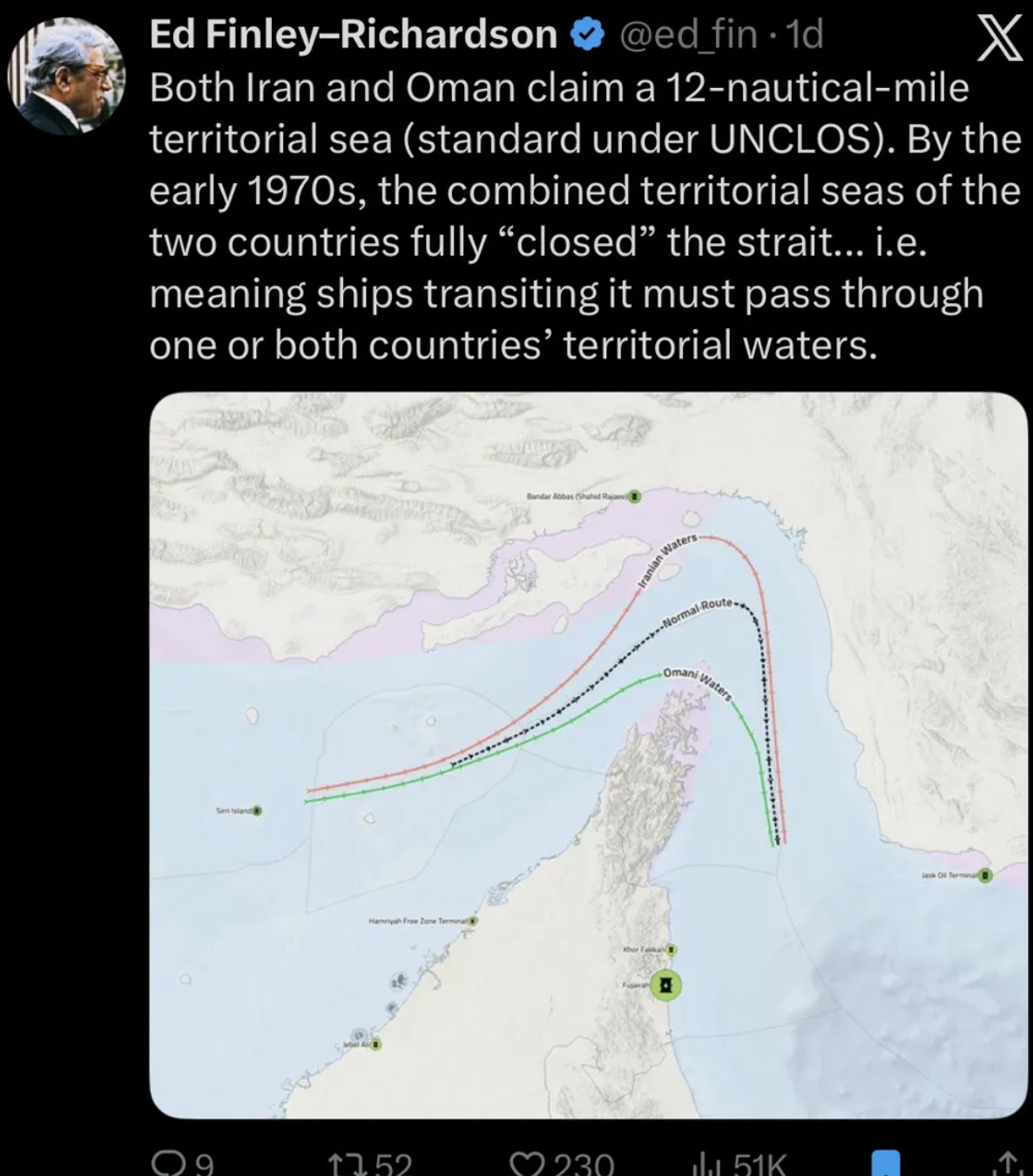
And what did our allies do? France joined Russia and China in blocking a resolution to reopen the chokepoint that their own economies depend on. Then got rewarded with transit rights.
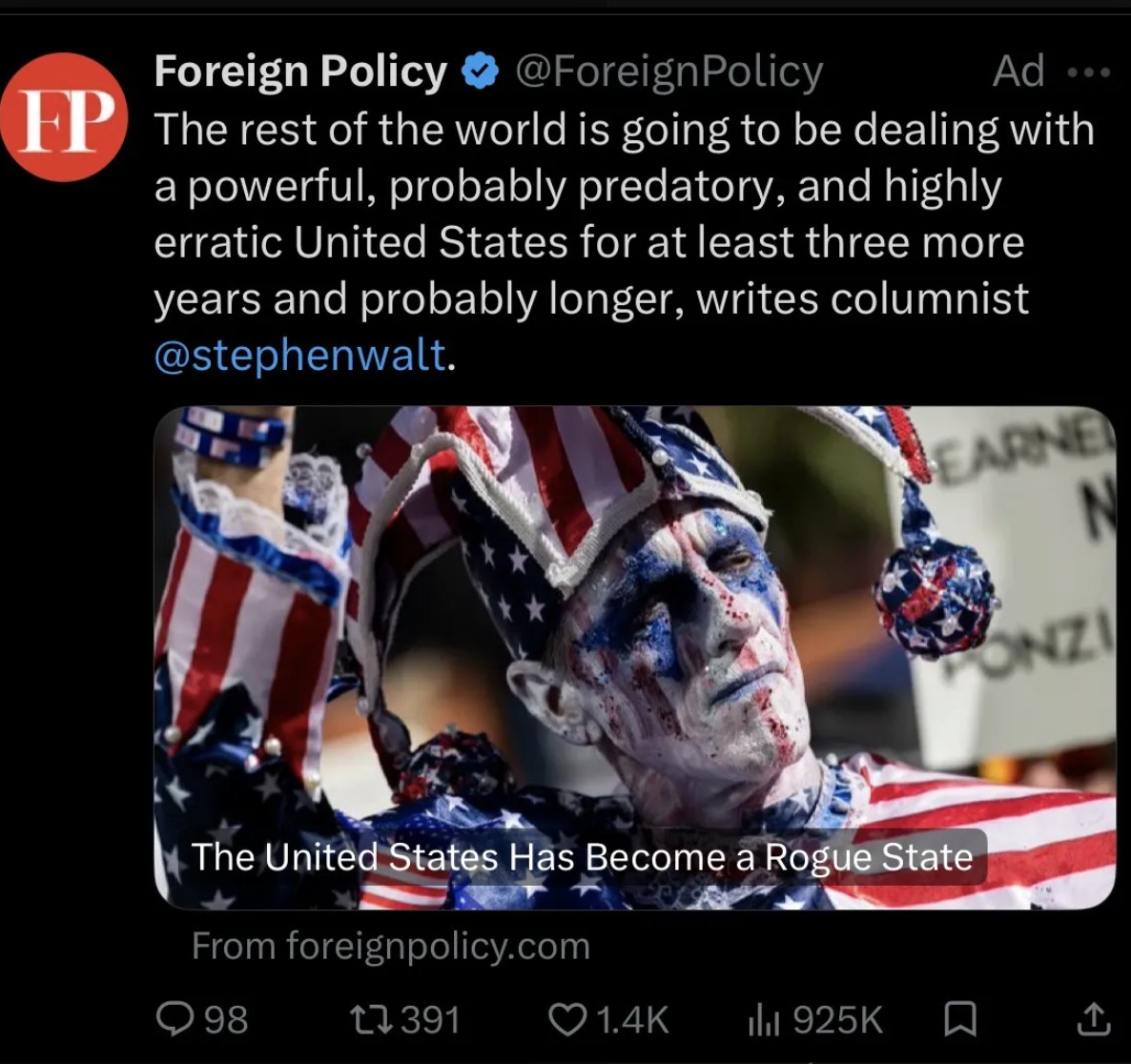
Funny. When I look at international law, the only world where it’s actually enforceable is one where there’s sufficient transnational power to enforce it. That, or something more than a hegemon. Arkhe, as the Greeks called it. Empire.
Here’s what the comfortable Western consensus gets wrong.
The result of all this is not multipolarity. Multiple power centers, mutual respect, rules-based interaction between equals. That’s what IR professors describe over wine in Geneva.
That’s not what happens when the hegemon weakens. What happens is fighting. The Concert of Europe collapsed into two world wars. Pax Britannica ended in catastrophic violence. The Delian League didn’t evolve into a cooperative Mediterranean forum. It collapsed into the Peloponnesian War. Every multipolar period in recorded history has been a period of conflict, because when no single power can enforce the rules, everyone writes their own.
The Europeans who were liberated by American soldiers understood this. Security has a price, and it’s being paid by someone else’s children. Their children resented the dependency but still grasped that the umbrella existed. The grandchildren forgot. They think peace is natural. They think open sea lanes are physics. They think the absence of great-power war on a continent that produced two of them in thirty years is the default.
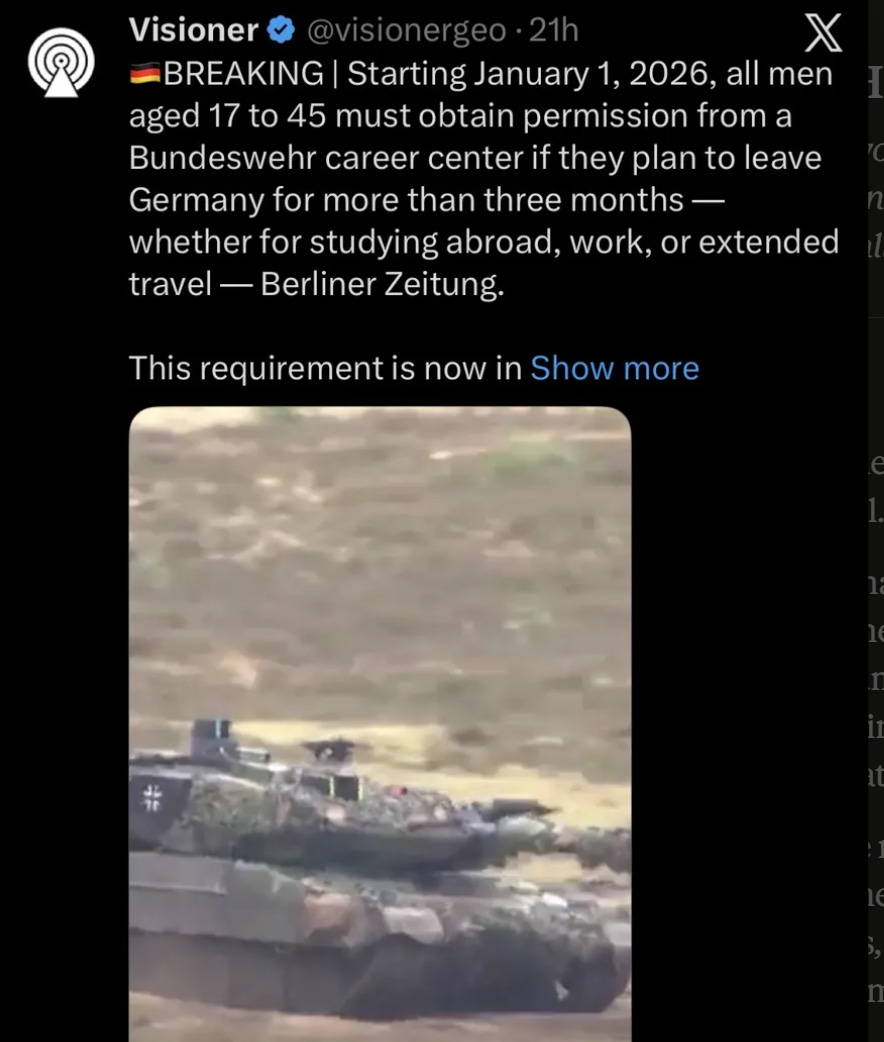
And the people who understand this best aren’t in Paris or Berlin. They’re in Kyiv. Vilnius. Tallinn. Warsaw. Watching their Western European neighbors cut side deals with the adversary and print money for social programs through TARGET2 but refuse to put boots on the ground. “Whatever it takes” if it means backstopping Italian sovereign debt. Not if it means Tallinn.
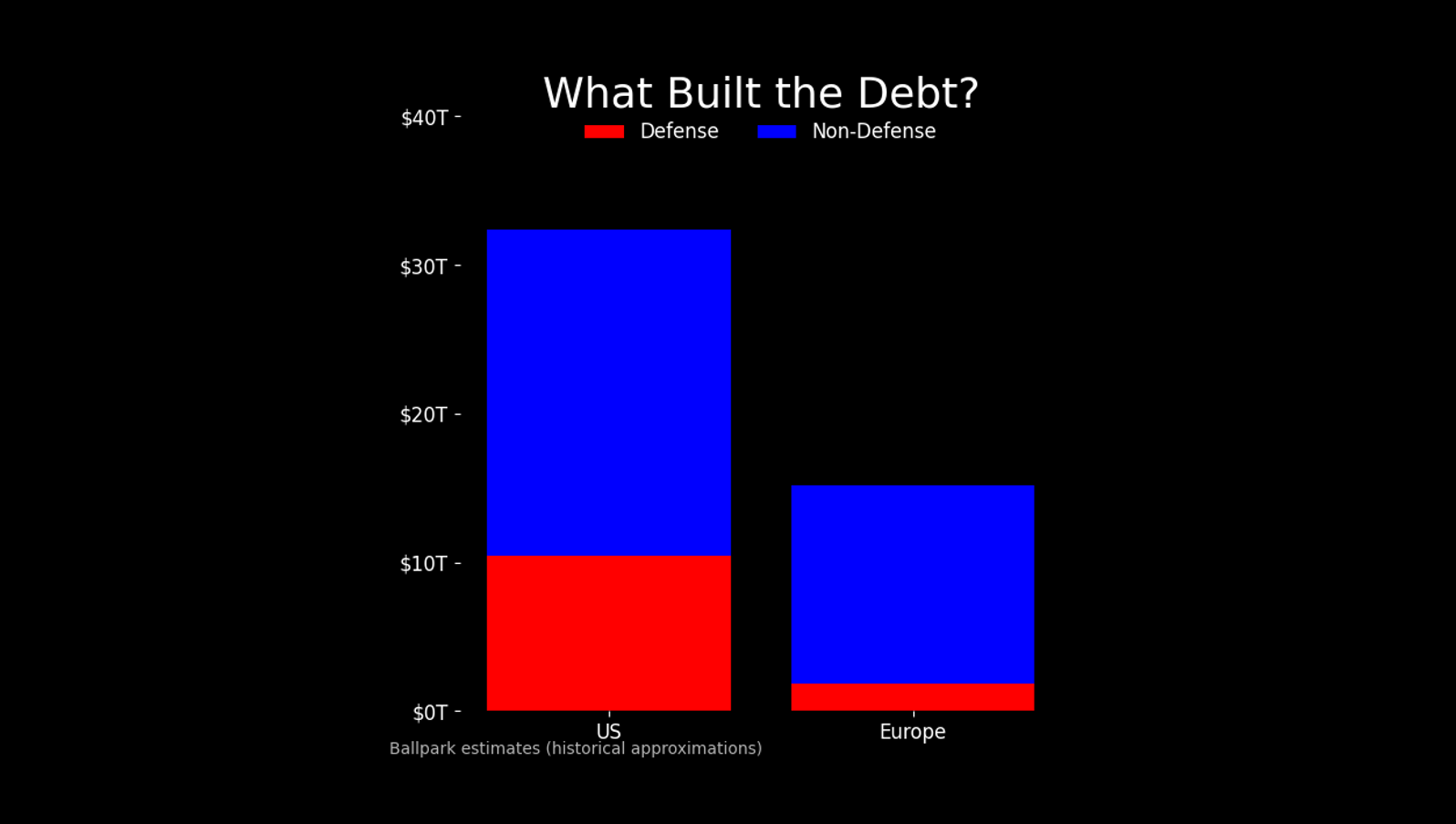
So here’s the backward induction.
If Russia and China aren’t going for the whole thing, for the dollar, for the order, then Trump is an irrational nativist and everything he’s doing is destructive. This is the consensus in the halls of power.
But if they are, then he’s early. And everything that looks like chaos is preparation.
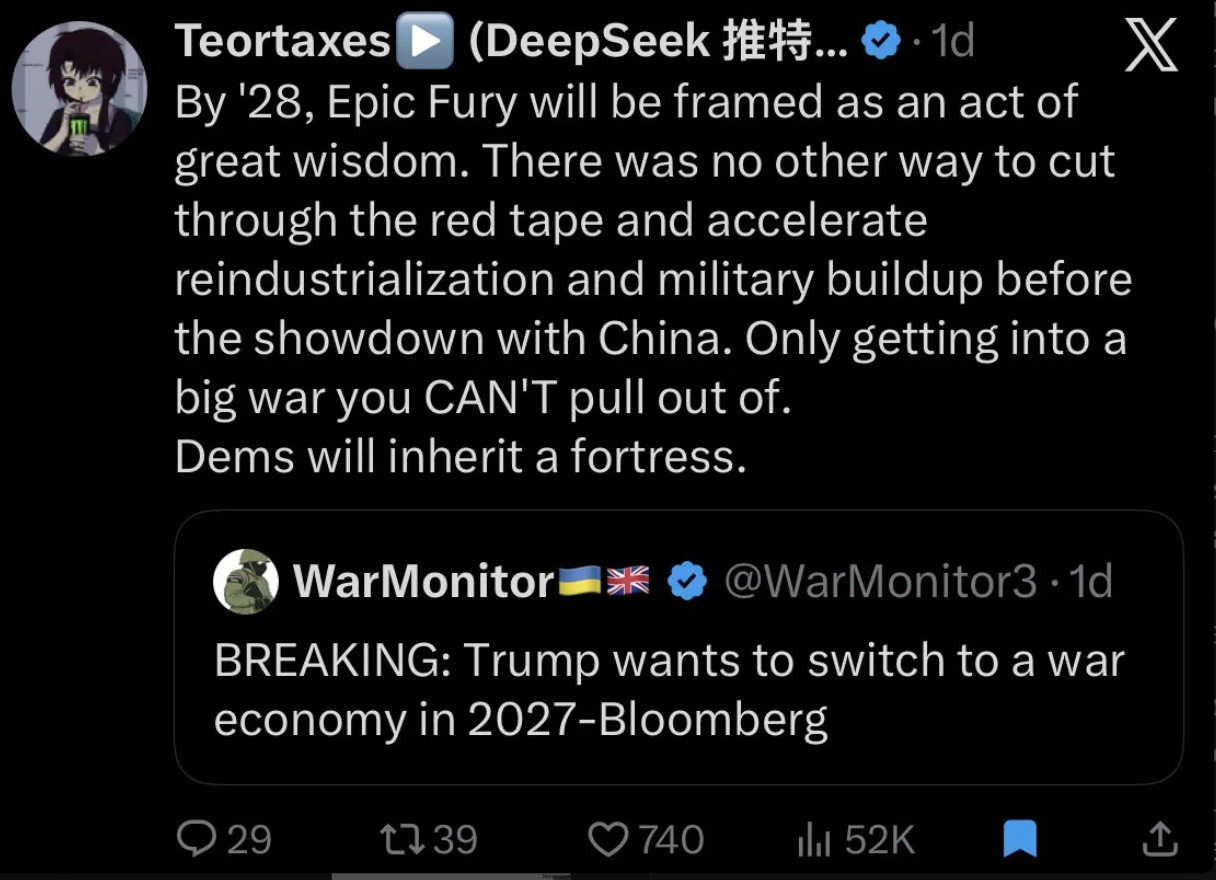
I’ve laid out why China can’t win the long game. The $5-7 trillion in hidden banking losses, the $1.1 trillion annual bleed, the resource bind. Their window is 2027-2030. The US wins the long game on energy, innovation, AI, and the dollar. The question is never the endgame. It’s the transition.
And the transition is where hegemonia dies.
Not because the hegemon wanted empire. We proved we didn’t. Seventy years of maintaining a security order that benefited everyone more than it benefited us. But hegemonia requires willing partners. Partners who carry weight. Who show up. Who don’t defect the moment the cost rises above zero.
The test came. Europe defected.
If you need a hegemon to have a world order, and the hegemon’s allies won’t be partners, the hegemon has two choices. Walk away and watch the scaffolding collapse into proliferation and conflict. Or stop asking and start imposing.
By challenging the old globalist order, the new axis thinks it’s building something multipolar. What I see is a period of chaos, conflict, and eventually, empire. By killing Athens, they beget Rome.
The tragedy isn’t American overreach. It’s that we tried, for eighty years, to lead without conquering. And the beneficiaries called it oppression while the adversaries called it weakness.
The Cascade.
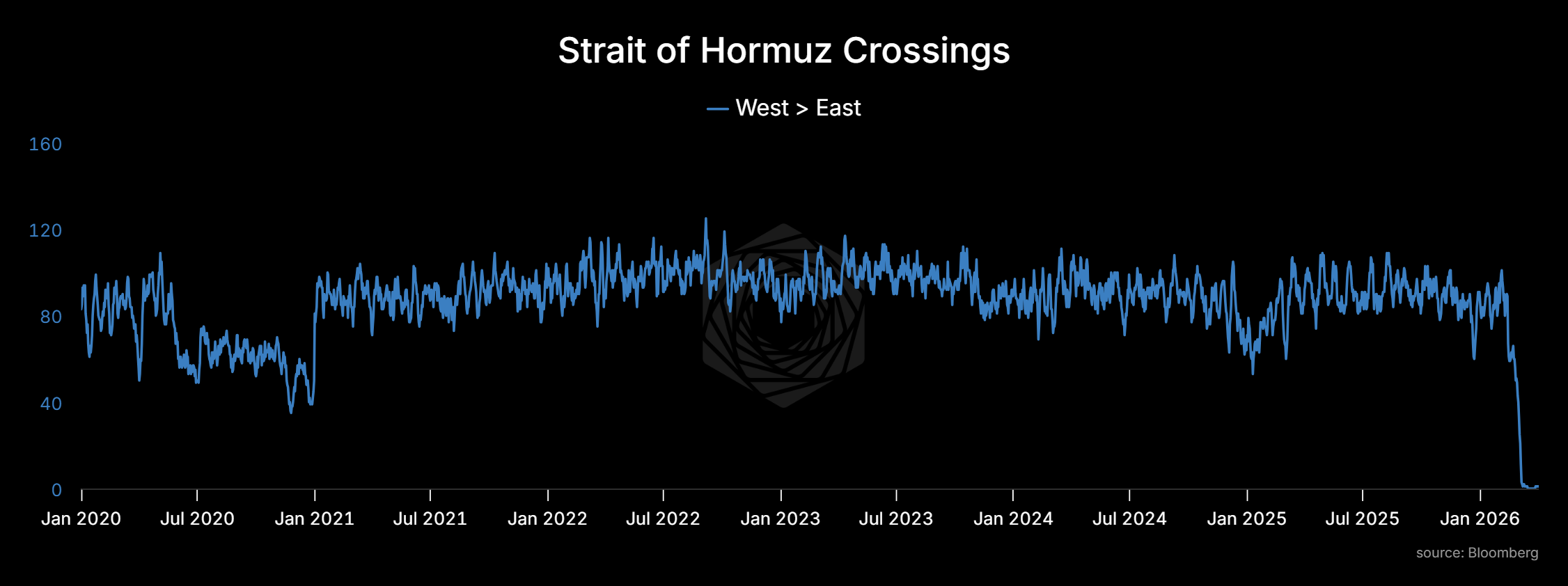
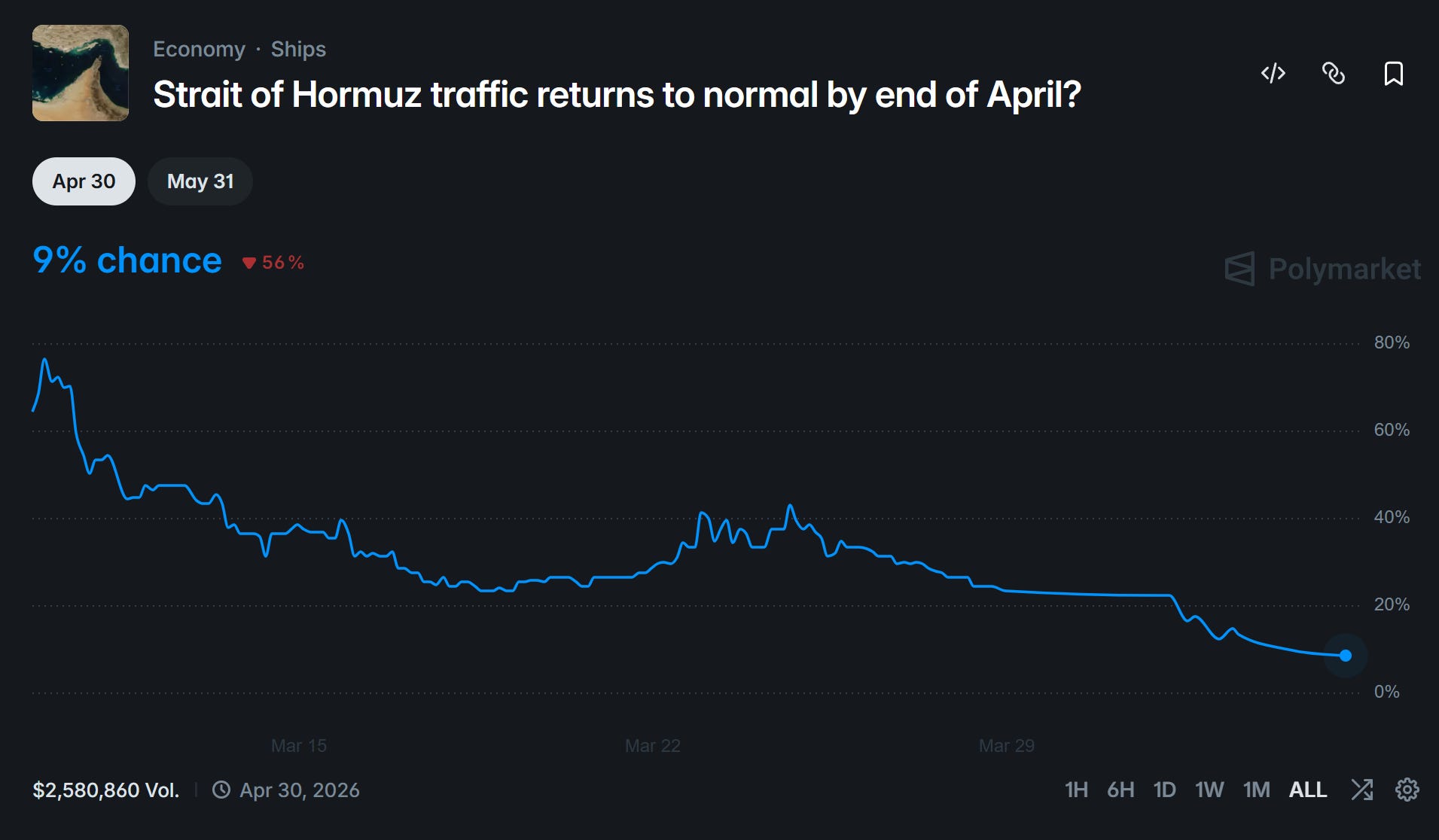
The Security Council can’t even get to a vote. The resolution has been delayed twice, watered down from “all necessary means” to “defensive measures,” and still faces vetoes from Russia and China. There is no multilateral framework for reopening Hormuz. It’s unilateral US action or nothing.
France’s side deal introduces something the market hasn’t priced: a fragmented Hormuz. Not open, not closed. A toll system where Iran decides who transits. A discretionary access regime with a geopolitical risk premium that doesn’t expire.
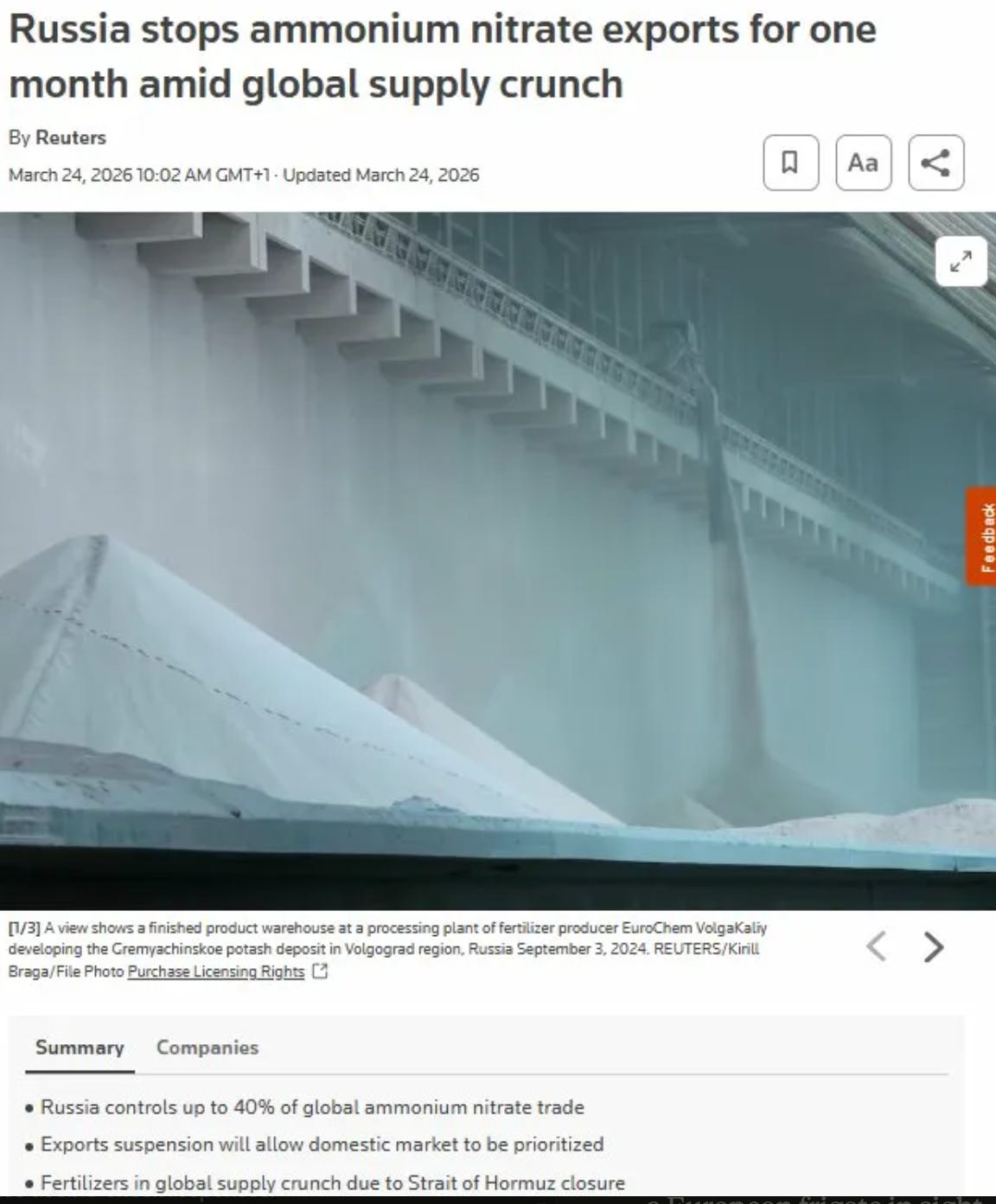
Energy disrupts fertilizer. Fertilizer disrupts planting. Planting calendars are immutable clocks. The cascade extends.
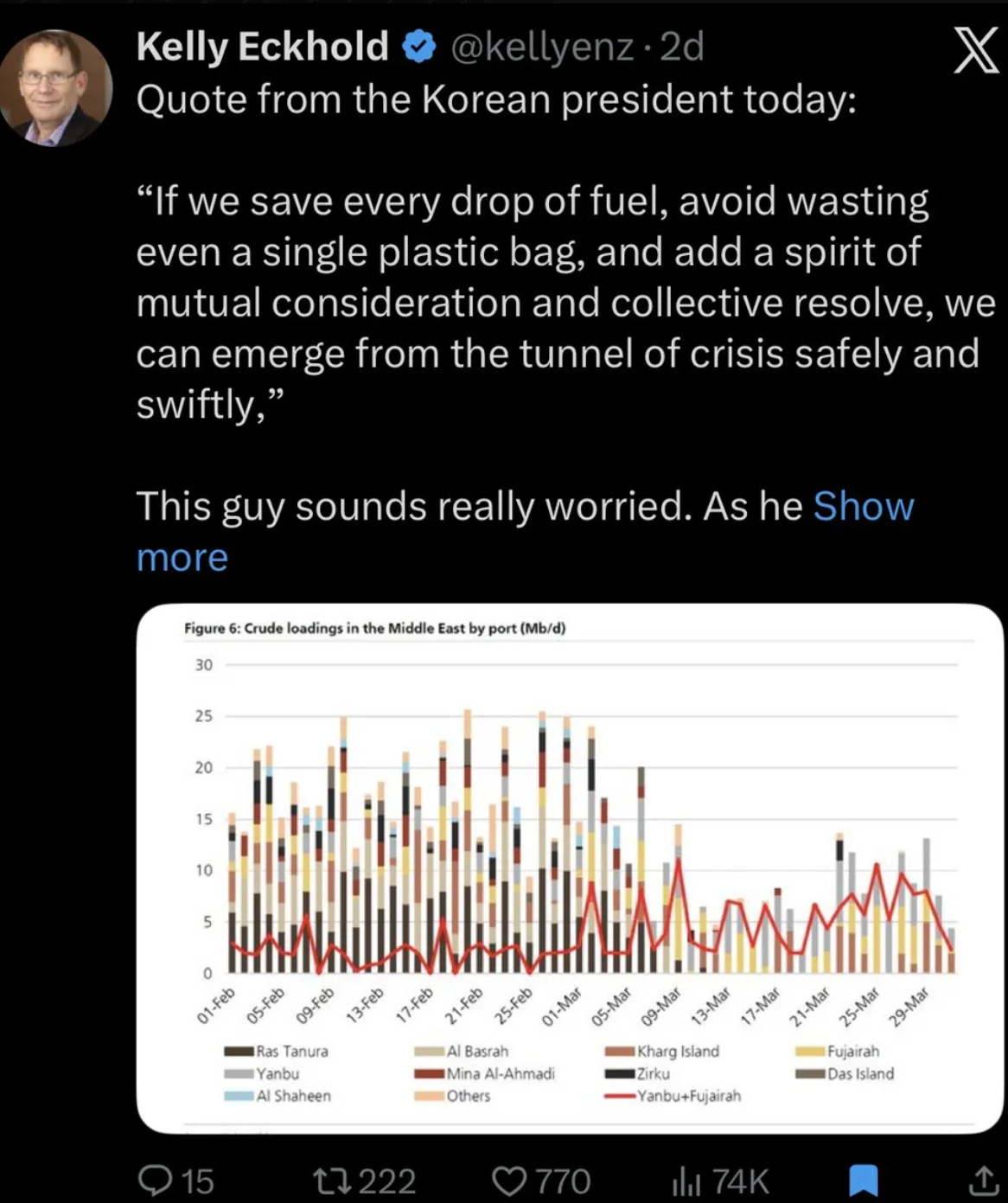
I’ve laid the framework out in “The Cascade,” “The Strip vs. The Strait,” and “All Eyes on Hormuz.” Today doesn’t change the thesis. It confirms it and extends the timeline.
And the people sitting in Paris cutting side deals for their own oil aren’t the ones who go hungry. The Strait is easing. A few ships trickle through. Oil may flow. But every day of restricted access, the damage propagates deeper into the system. Fertilizer. Planting windows. Aluminum. Helium. Sulfur. Polyethylene. Ammonia. Methanol. LPG. LNG. Neon. Urea. Petrochemical feedstocks. Desalination energy. Everything downstream of a barrel that isn't a barrel. These don't snap back when the first tanker clears Larak. The cascade doesn't care about diplomacy. It runs on calendars and chemistry. We remain positioned defensively, and we remain worried. Not about crude. About everything crude feeds.
Disclaimers
I value your opinion here but don’t agree at all. I love the us but your president is as dement as the one before him, surrounded by yes men (cabinet meetings resembling North Korean ones) sleep walking into a conflict that is deeply unpopular (wasn’t trump running on stopping the forever wars in the mid-east?) which he cannot control anymore. Then crying for allies to help to get him out of this mess (after the fact and 1 month after threatening them to annex part of their country). No 3-d chess and only losers besides Russia and Israel
It would’ve greatly helped the argument for the US over the last 20+ years if you guys dropped the white knight of the world bs. I fully support Trump’s moves against China and I agree current European leadership are a bunch of shortsighted retards at best and paid off traitors at worst. But this idea that the US did things like the Marshall Plan out of the goodness of your heart and because it just wants everyone to be free doesn’t really fly after you lose interest in crayons