


The War for Hormuz
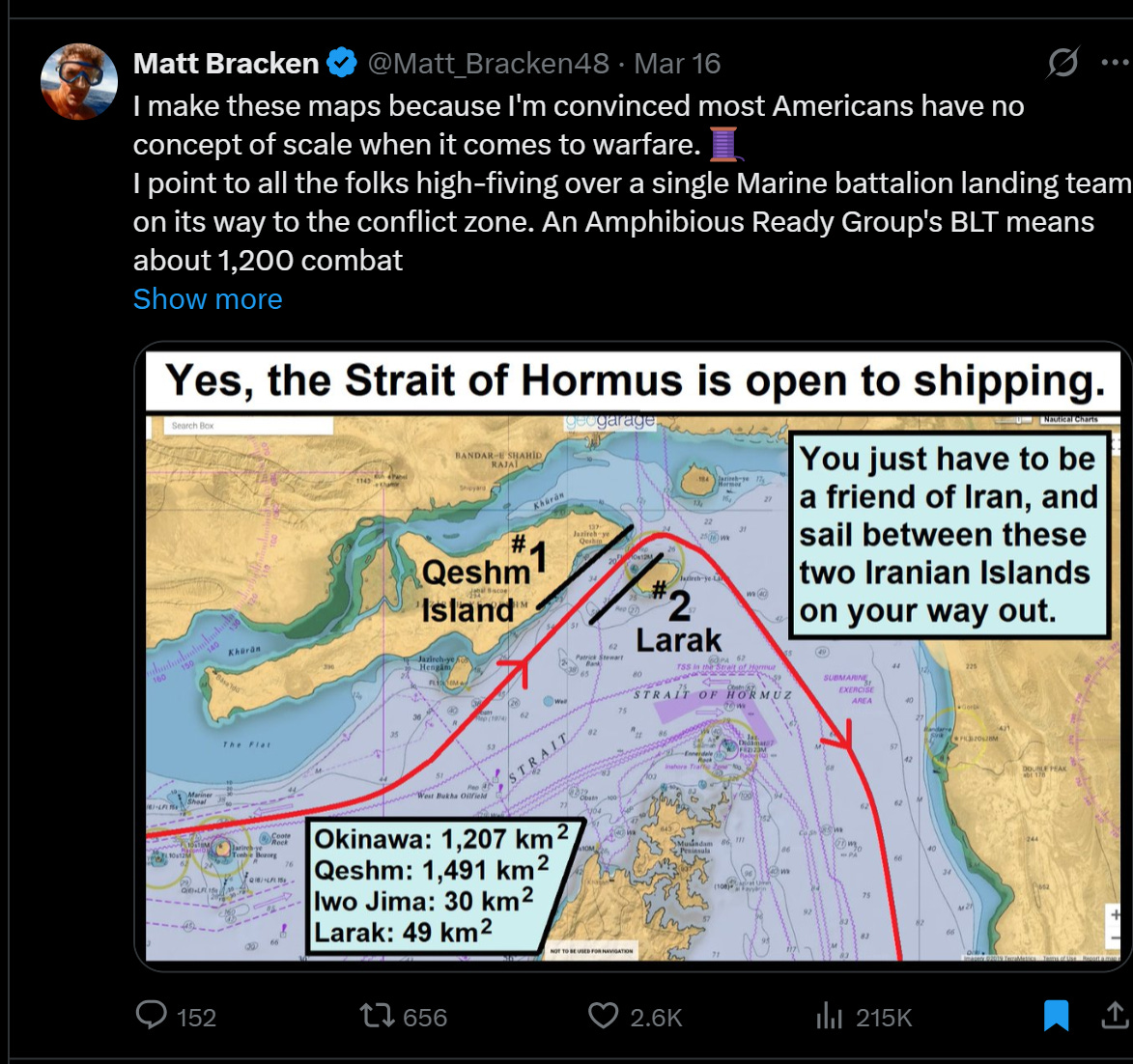
Iran’s declaration last week contained two conditions for safe passage through the Strait of Hormuz: a) you are a friend, and b) you are willing to price your oil in CHINESE YUAN.
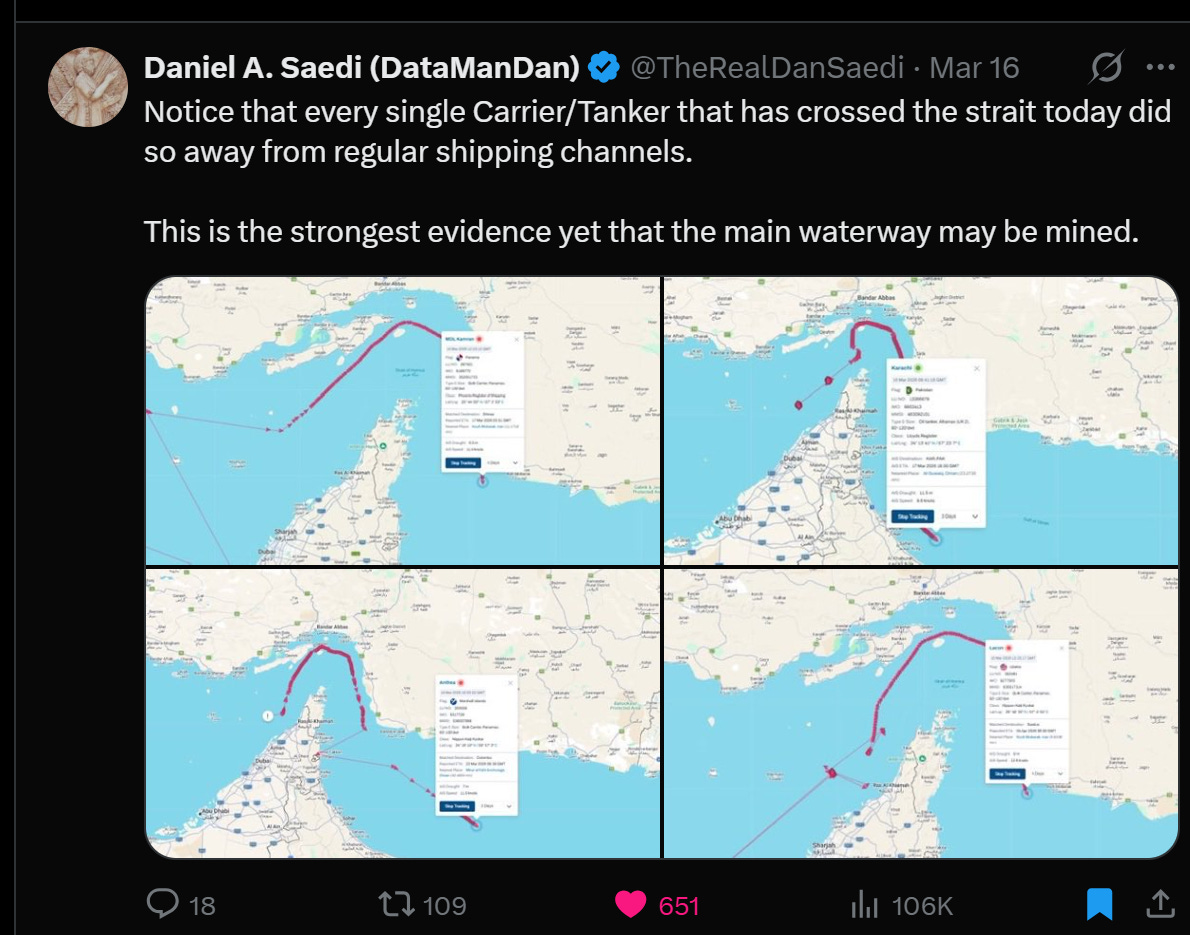
If you needed clearer evidence that we are in an age of decoupling, and that this is about those that would seek to overturn the world order vs those that seek to preserve it, this is your most clear signal.
When was the last time your side in a war was determined by which reserve currency you used? (Answer: Napoleon's Continental System, 1806.)
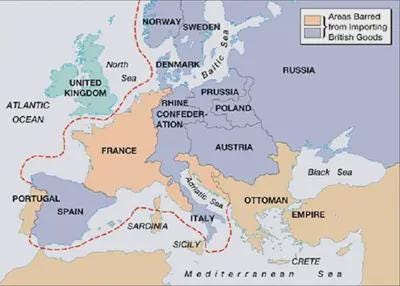
This then led to two interesting, somewhat unsurprising, responses.
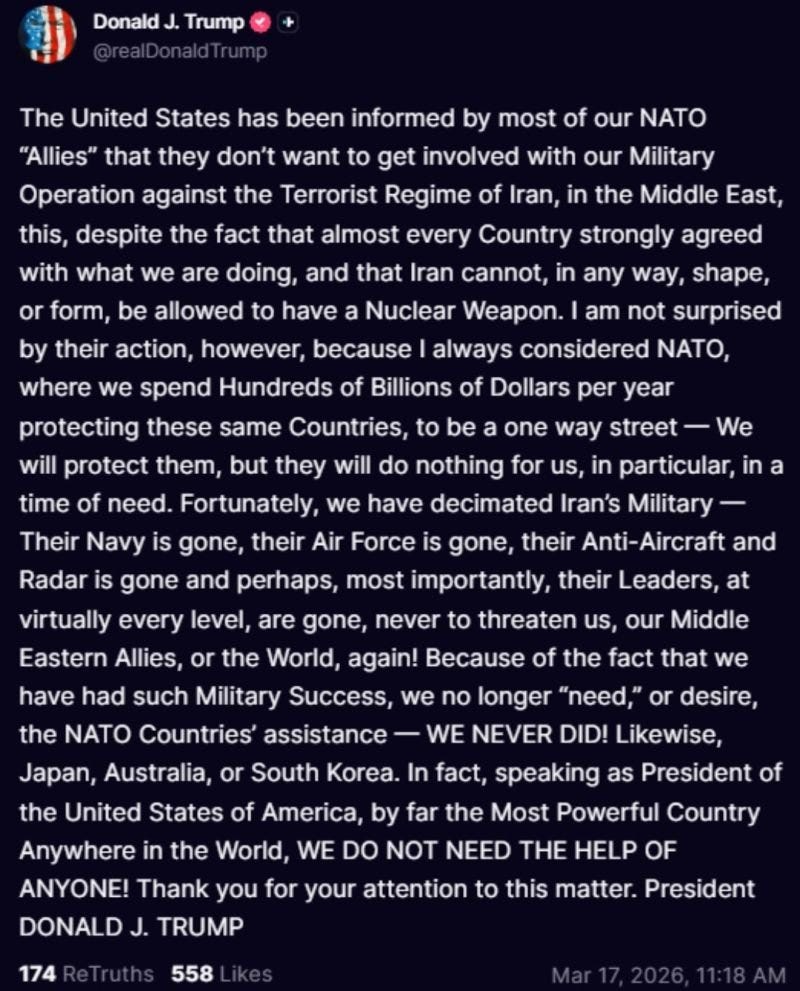
First, Trump has made an open call for those who would opt into a coalition to reopen the strait. With the obvious dithering by the Europeans. Who feel, yet again, that this is not their fight nor something they should be on the hook for. Funny though, they had the same opinion about Ukraine as well for a while before they started getting drones and missiles skirting their airspace.
Second, the call to CHINA, to see if they would be willing to participate. With the obvious non-answer / no (remember they are too busy trying to suck up as much information about how the US wages war, and test drive their counter systems, to really want this conflict to stop).
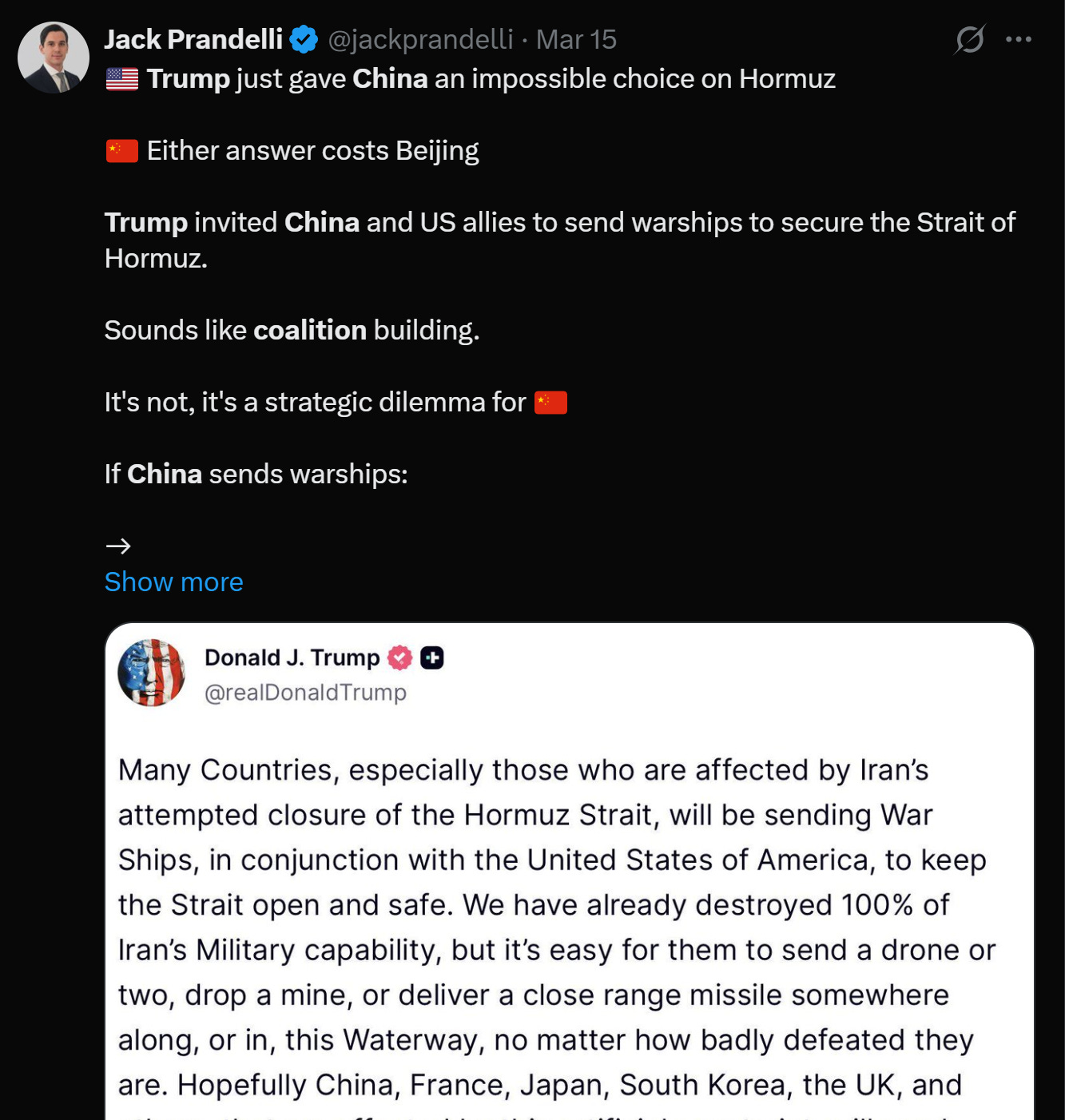
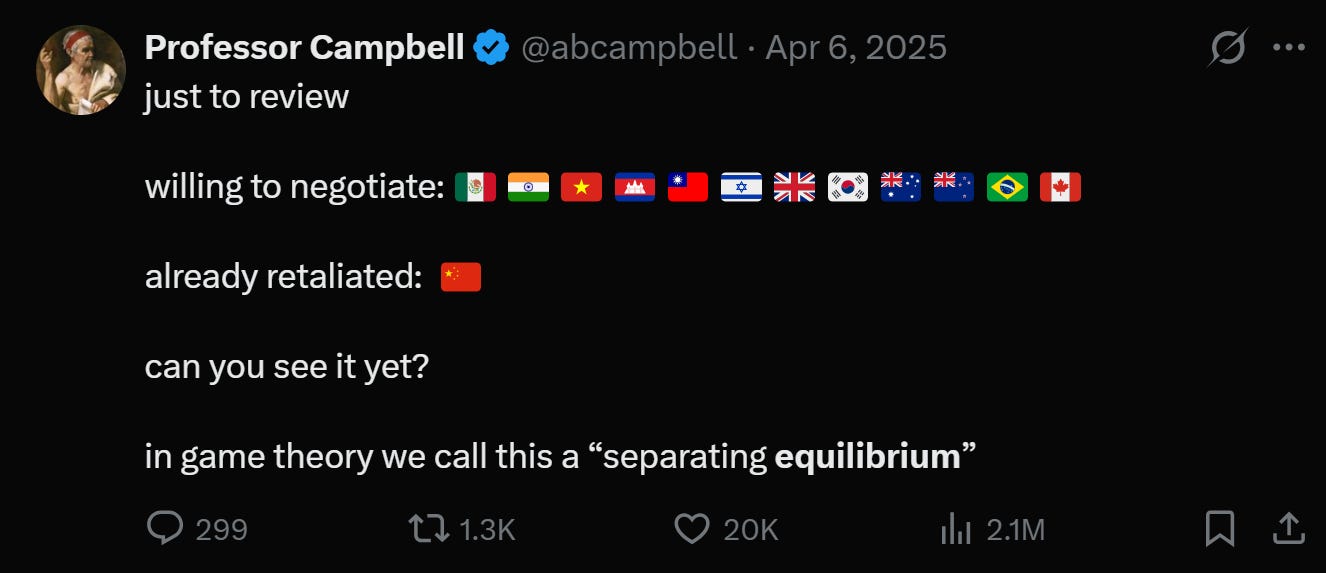
Low information folks might see this as flailing, but it’s really an extension of the ‘separating equilibrium’ strategy I identified almost a year ago back in the era of Liberation Day. Sometimes the only way to plan a party is to ask people to help plan it, that’s when you see who your real friends are. Otherwise you end up with a lot of ‘cheap talk’ yeses, a bunch of flakes, and too much guacamole.
What’s unique about this party though is it’s one the Europeans don’t really get to opt out of. Remember the US is an energy exporter. We make the shale. We send the LNG.
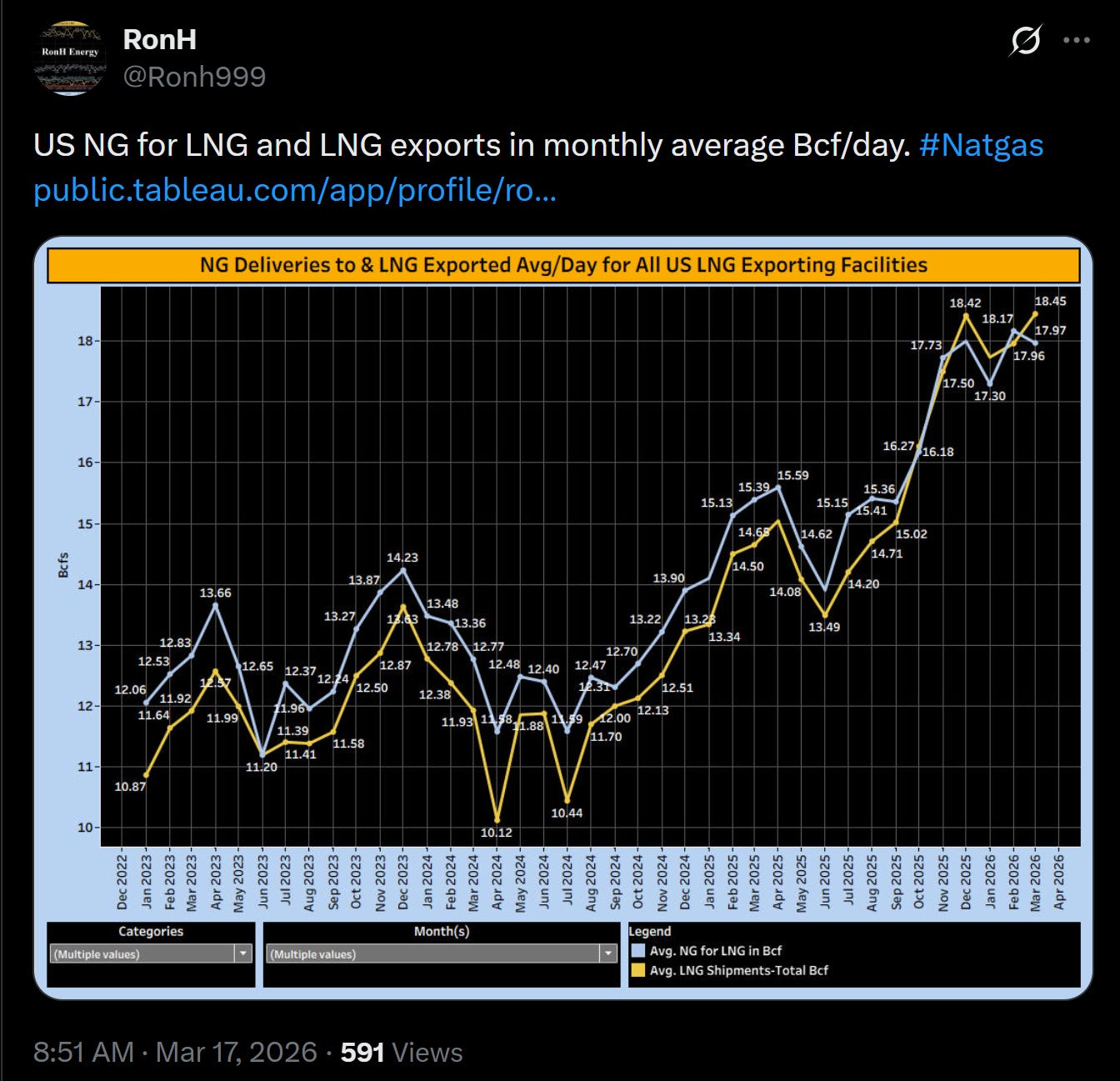
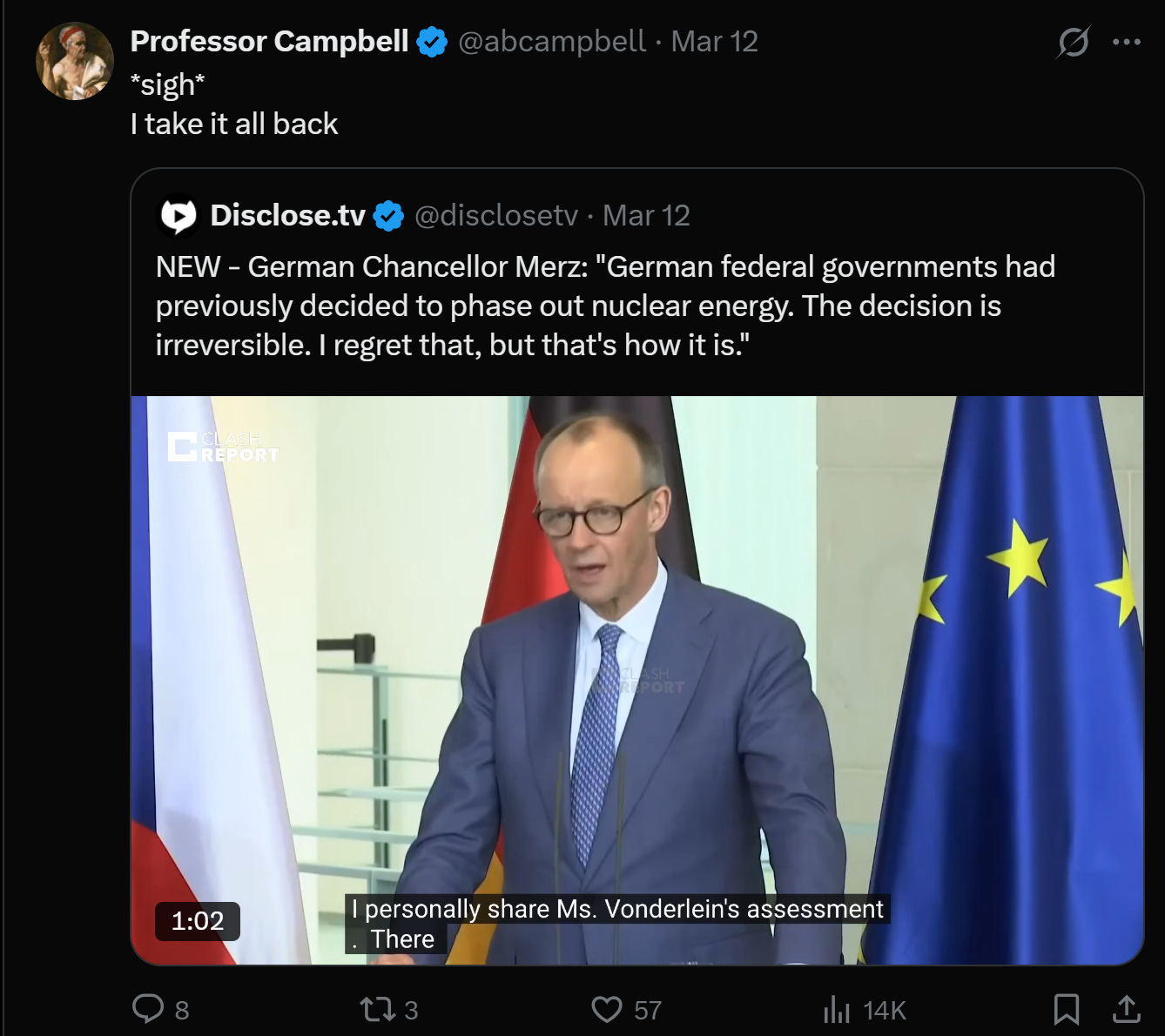
We have so much petroleum we don’t burn coal just because it makes us feel bad. Sure we’re a little slow to get going with nuclear (as expected) but at least we don’t have leaders like in Germany saying ‘oh no we turned it off now we don’t know how to turn it on again,’ another in the seemingly endless double speak wishy-washiness coming out of the continent (sorry guys I love you and we need you, you gotta wake up).
Just like with Russia, whether they want it or not, their energy dependence means they are in this game. They didn’t choose the starting clock, but they are on side. If they really want to opt out, they can deal with Russia alone. Time to choose a side. Decoupling is coming.
Lastly, and maybe I’m being a little naive here, there were the overtures obviously being made to Russia right now.
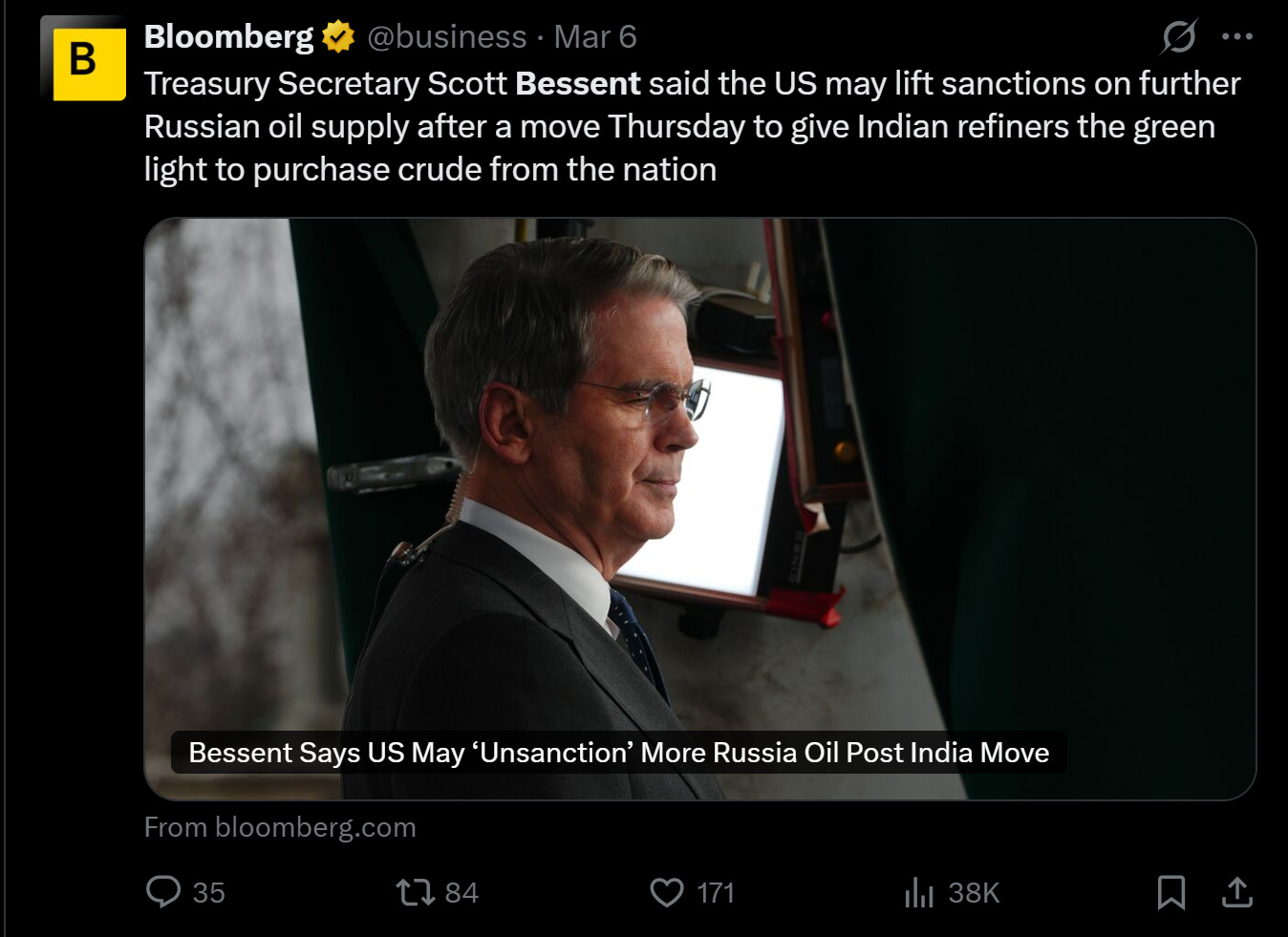
Loosening sanctions on their energy exports at exactly the moment they look weak on the battlefield
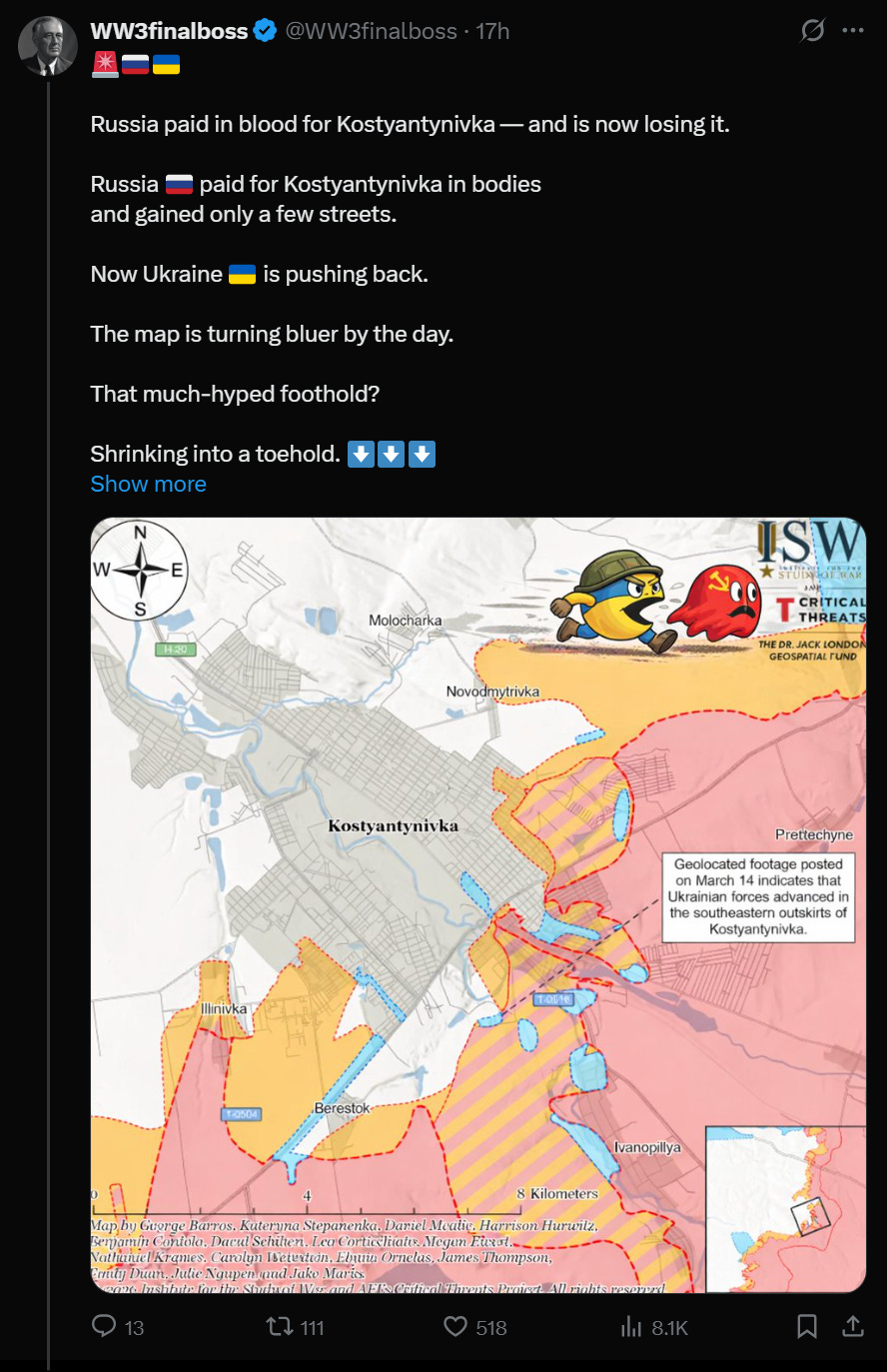
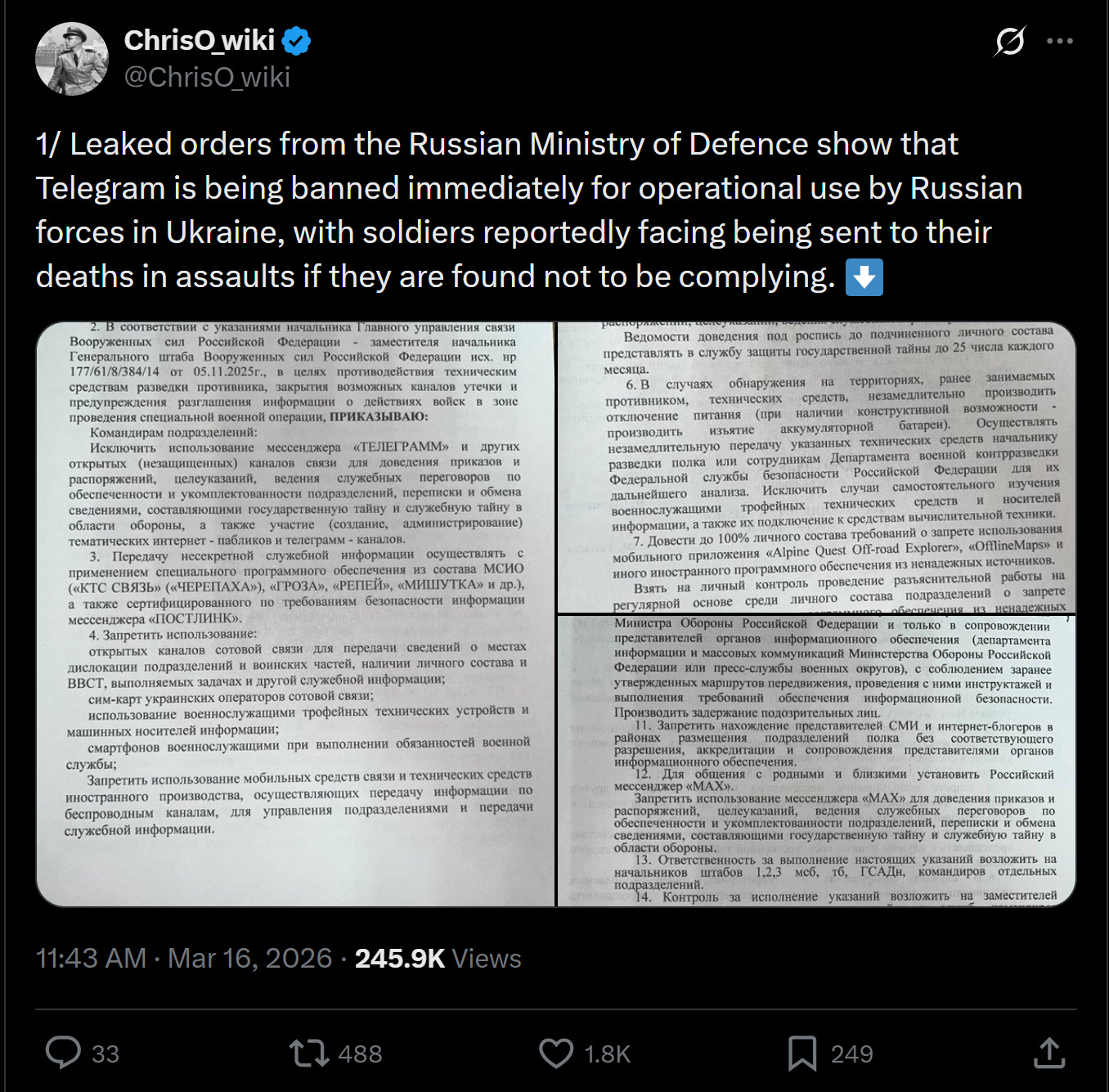
and unstable at home.
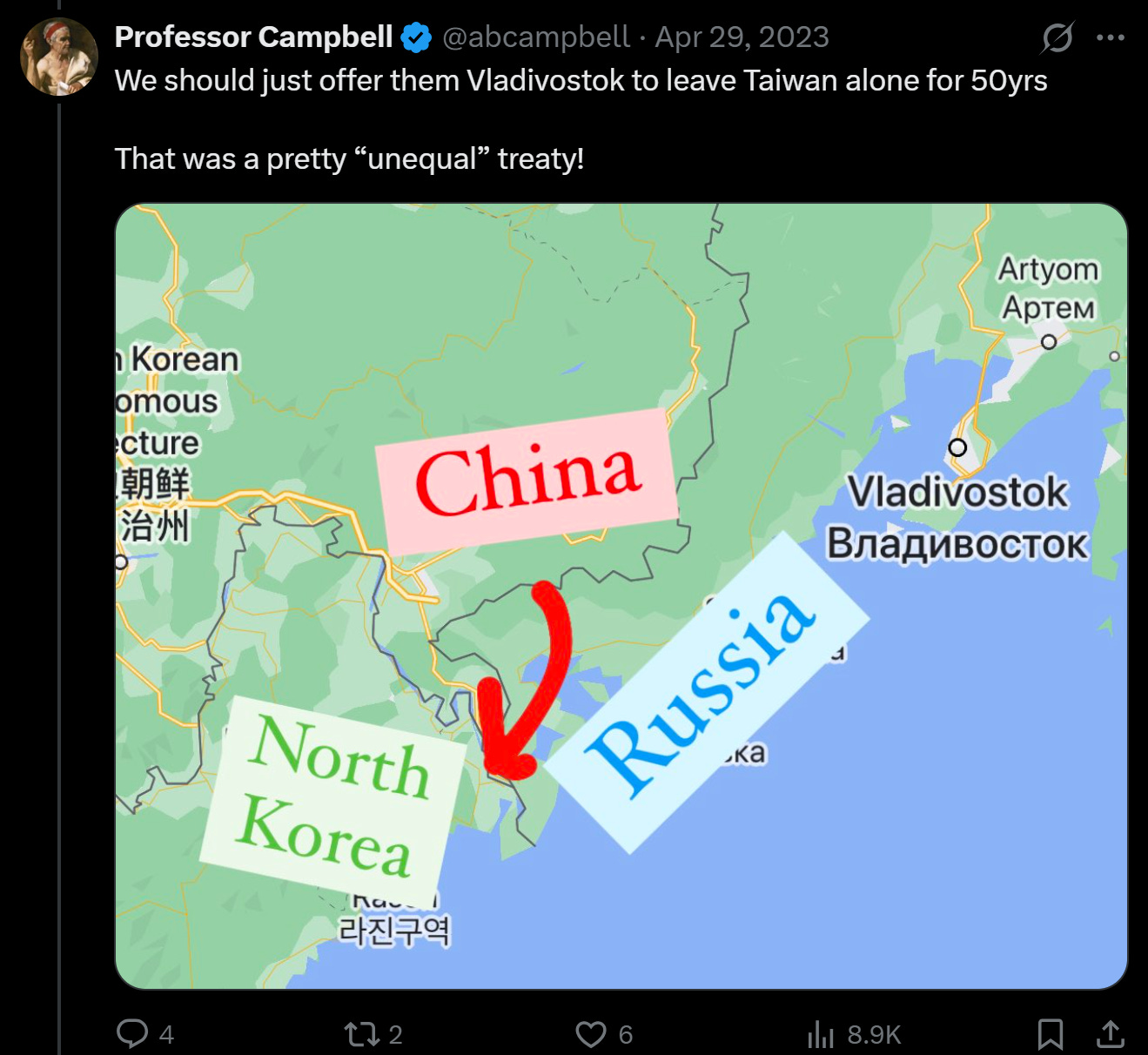
Maybe there IS a deal to be struck with Russia. Maybe it’s possible to pull them, ever so slightly, out of the Chinese sphere of influence. After all, Vladivostok, the eastern ports, and all that nice farmland is RIGHT there, and oh wouldn’t it be a shame if the conflict in Europe tore them into a hundred pieces and China picked up the best parts of Siberia, which after all, were robbed from them by European colonialism during their century of humiliation.
Call it wishful thinking, but like Germany and Russia in 1940, the Sino-Russo alliance is NOT stable, and wouldn’t it be the ultimate coup for Trump if the conflict in Iran opened up the trade space with Russia to bring them back into the European fold. Not only would it chill out all the WW3 talk, but it would solve Europe’s energy problems, without which their economies might just collapse in a heap of debt and failed promises. Again, call it Campbell’s wishful/delusional thinking (the counterweight to Prof Jiang/Professor Dalio’s end of the American empire vibes) but it’s on the table now.
Is This the End of the American Empire?
Leave it to Ray to come out of the woodwork and try to frame the conflict in Iran in incredibly stark and binary terms. “If the US can’t open up Hormuz it’s the end of the American empire,” basically.
Pardon the text wall, but that’s how I read the following:
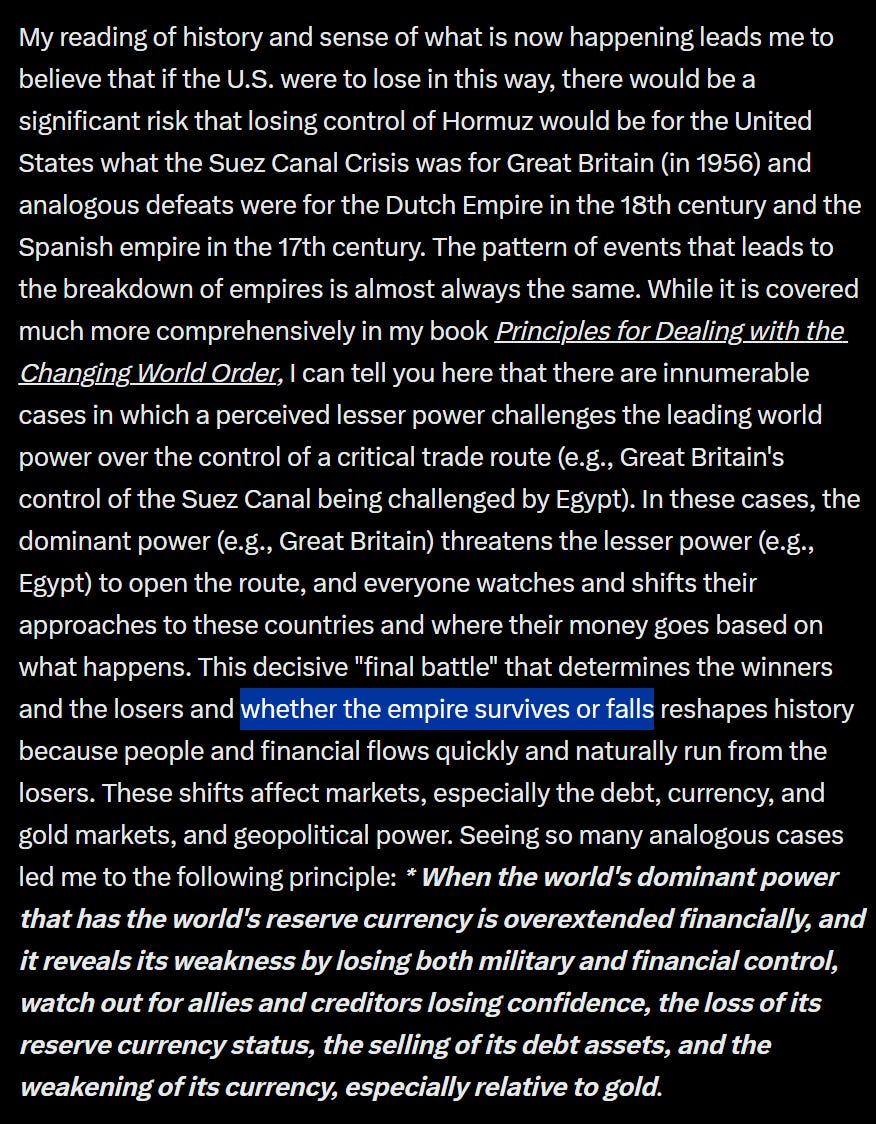
Now, I’m with Ray that all this stuff is fundamentally bullish for gold (though the market isn’t acting like it, reasons for which we will explain later), but I’m not 100% with him that this is like the end game for the empire if the US comes away with a couple of bruises.
Seems pretty clear that Ray is talking his book here, literally, the one where he draws a straight line to the end of the American empire. Me, I think the battle for Taiwan is a lot more important than the battle for Hormuz, even though yes, it’s pretty important. Why? Well, what Ray kind of forgets about Suez is that:
By the time the UK and France failed to exert their power in the Suez, they had already lost their empires, having sacrificed all their blood and treasure to defeat the other erstwhile empire emanating from the heartland, Germany, and
Part of the reason they were powerless in Suez was because the mantle of global empire had already been passed onto their ALLY in those two world wars, which was, also not coincidentally, a Rimland power, the US.
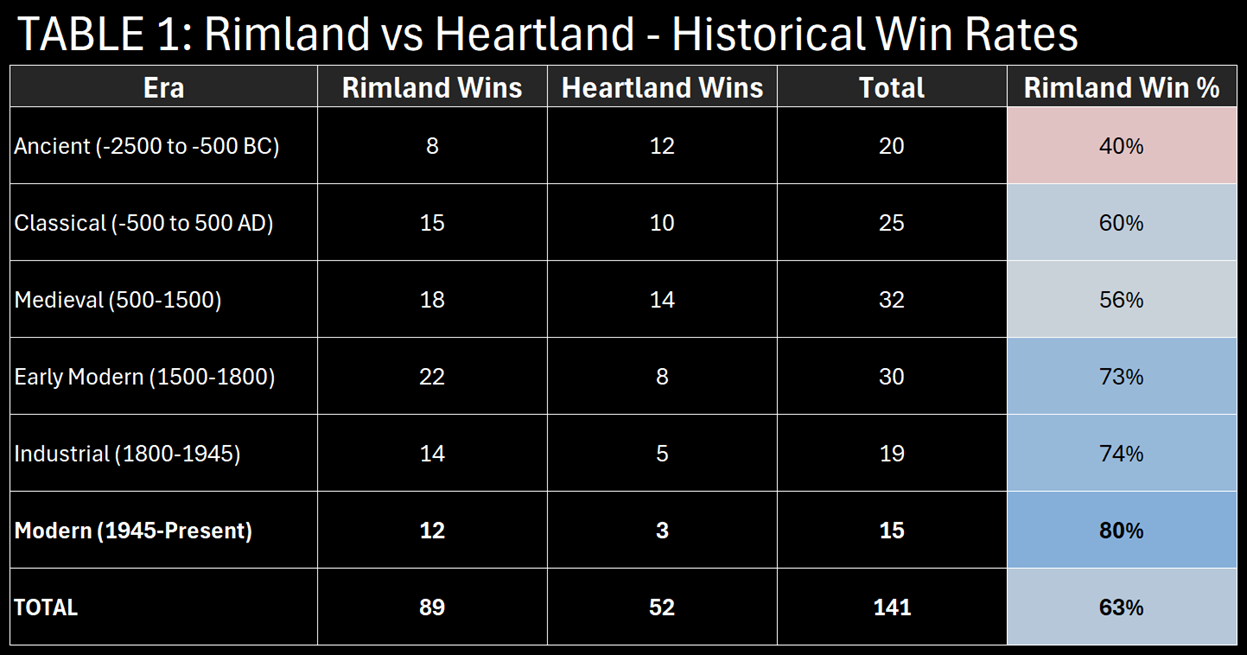
The point here is clear. As we mentioned in our piece this fall, the primary way this leads to calamity for the US is if it gets dragged into a conflict it cannot win in the Heartland. Which, if we're drawing parallels, provides pretty clear advice to policymakers. No boots on the ground. Especially not in the mountainous mainland.
Don't Invade the Heartland

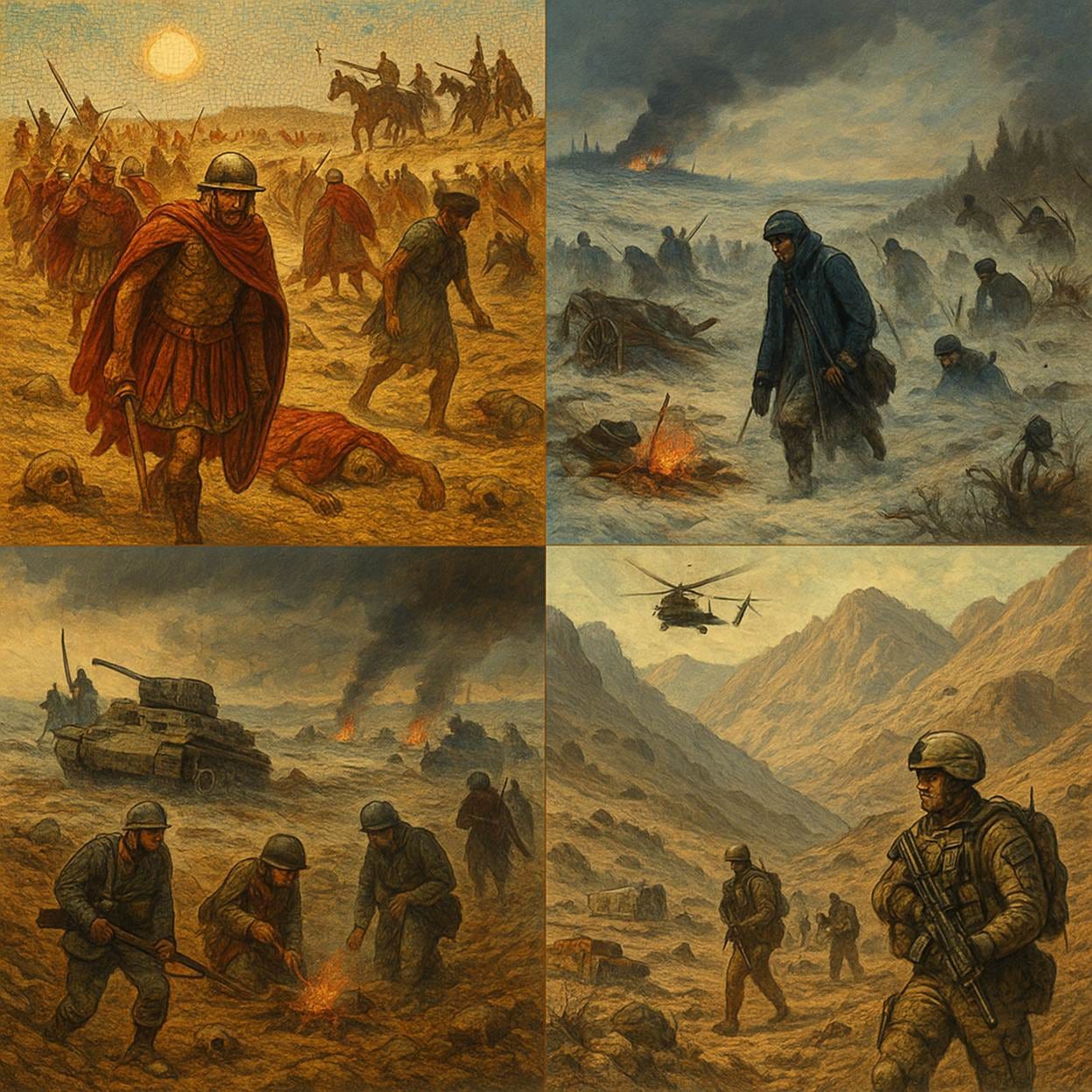
Marcus Licinius Crassus was the richest man in Rome. Member of the First Triumvirate alongside Julius Caesar and Pompey. Made his fortune in real estate and silver mines. Wanted military glory to match his colleagues.
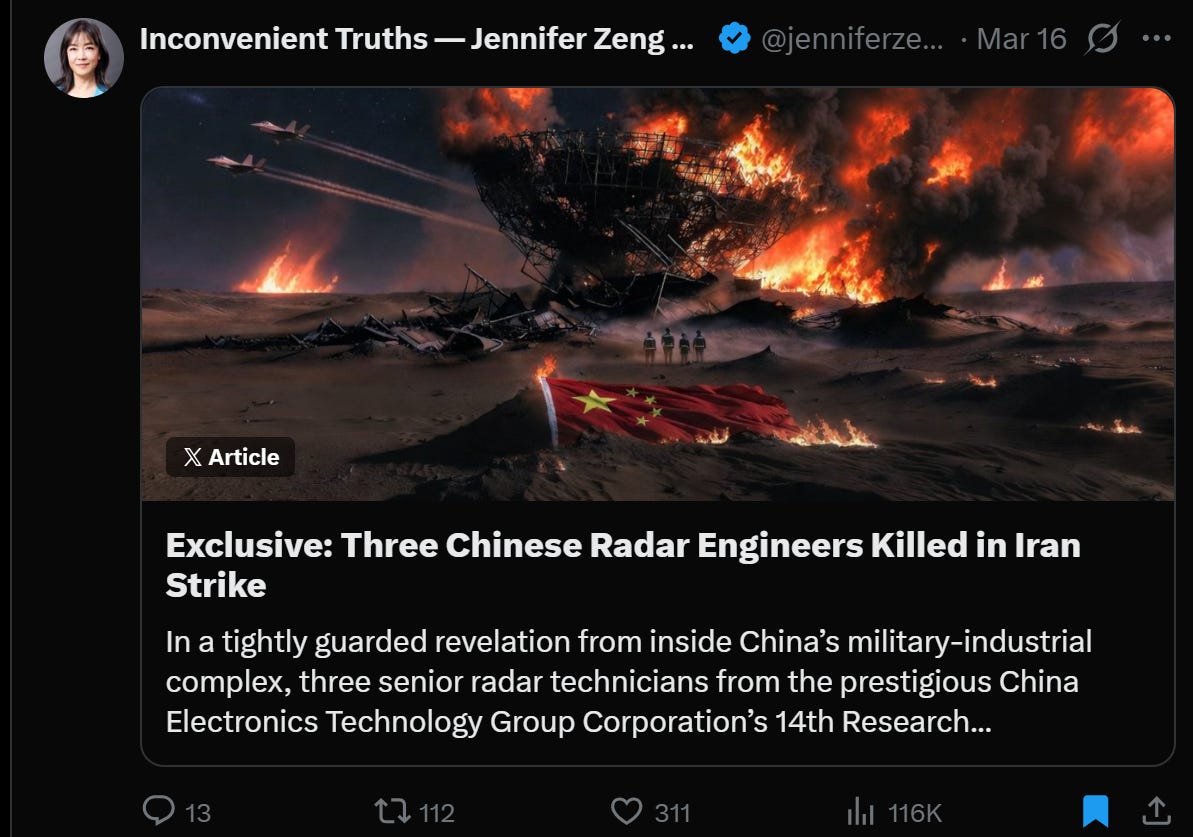
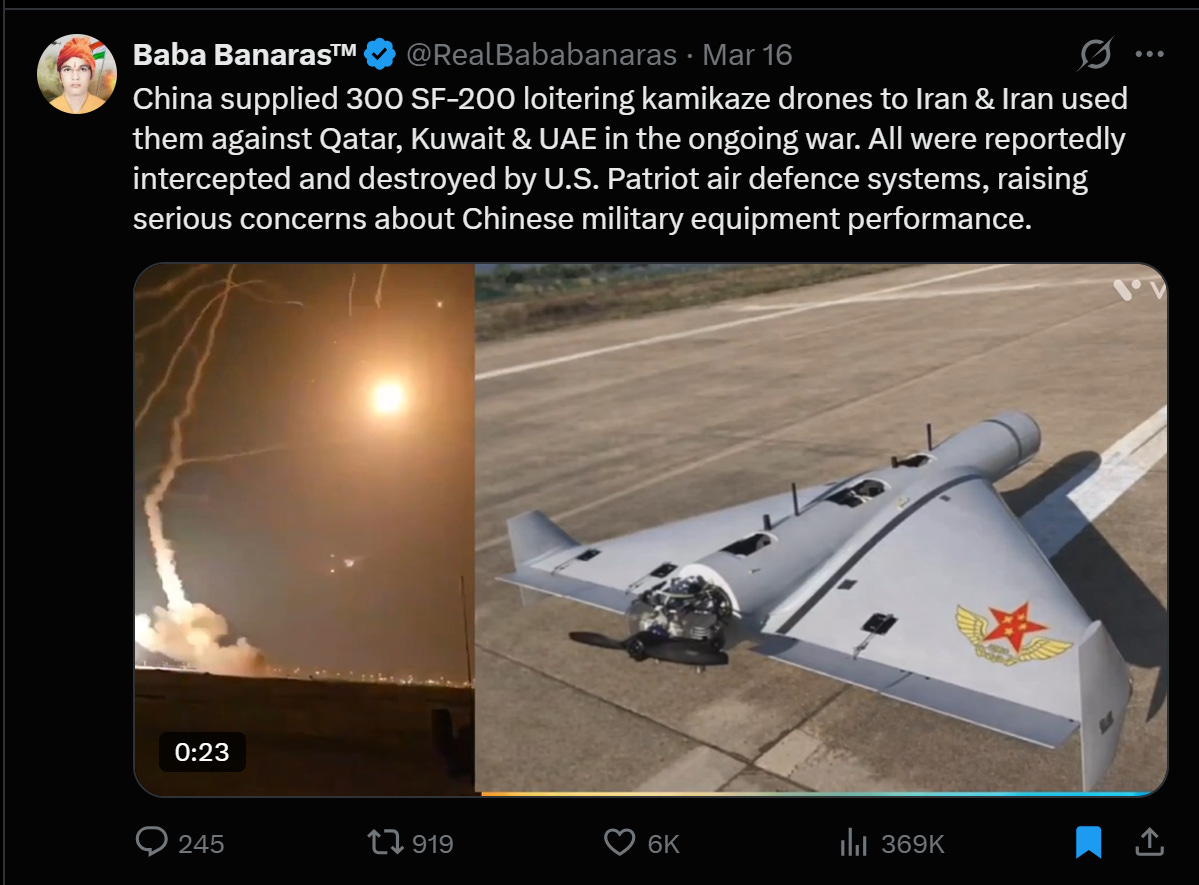
For Ray's historical parallels to work, you would basically need China to come to the rescue of Iran via naval power. Providing anti-air and drone manufacturing power alone will not do (though it seems pretty clear they are doing that too, especially if the reports that a bunch of Chinese radar and drone folks were casualties of US strikes are to be believed, which who knows!).
In a sense (not to say I told you so), we are STILL trapped in an escalatory game of tit for tat, which inevitably metastasizes a zero sum game into a negative sum game (I pay, you lose). These cycles are incredibly difficult to get out of, especially when the most bellicose players are a) in power, b) lacking off ramps, c) possessing a lot of paths to continued escalation in ways that hurt the other but don't disable its ability to continue the fight.
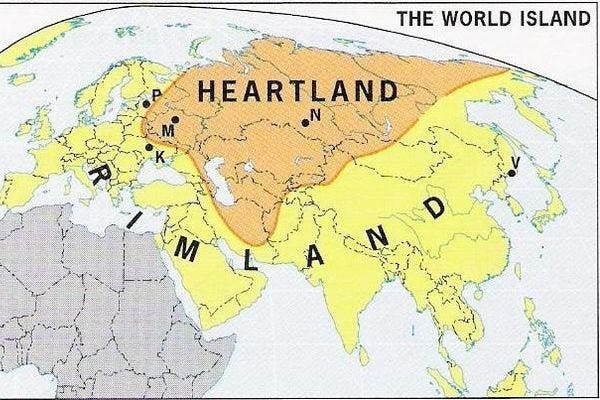
Rimland Wins By Doing Rimland Things.
What Ray and the end-of-empire crowd are right about it that Iran is a Heartland trap.
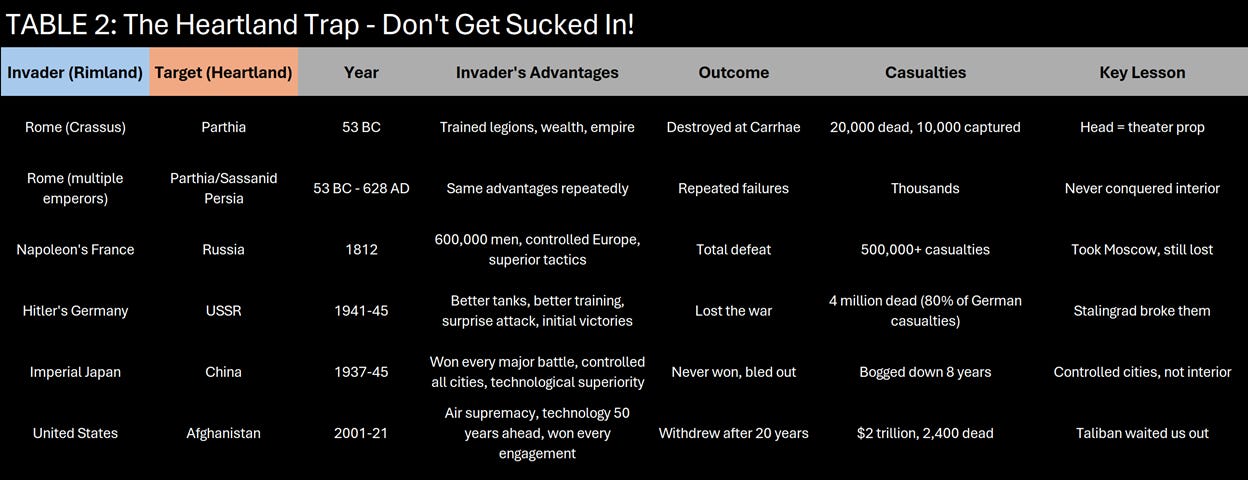
What they are wrong about is that the US doesn’t have to take it (by setting boots on the ground).
Ray and Jiang’s assumption is that the only way to ‘win’ Hormuz is to go in and physically control it. Boots on the ground. Occupy the strait. Fight Iran on its own terrain, in the mountains, on the mainland. That’s the Heartland playbook, and it’s the one that would actually end the empire, because that’s where empires go to die. Ask the Soviets in Afghanistan. Ask the US in Iraq. Ask literally anyone who’s tried to hold the interior of the Middle East by force.
But the US doesn’t have to play that game. It’s a Rimland power. It has aircraft carriers. It IS the sea. Iran’s whole leverage here comes from strangling one chokepoint. From LARPing as a Rimland power vis-a-vis the Gulf states. Fine. But think about what that actually means for them. They need to export oil too. Their ships are on the water too. Their economy runs on selling crude to China, and that crude has to travel through waters the US Navy controls far better than Iran does.
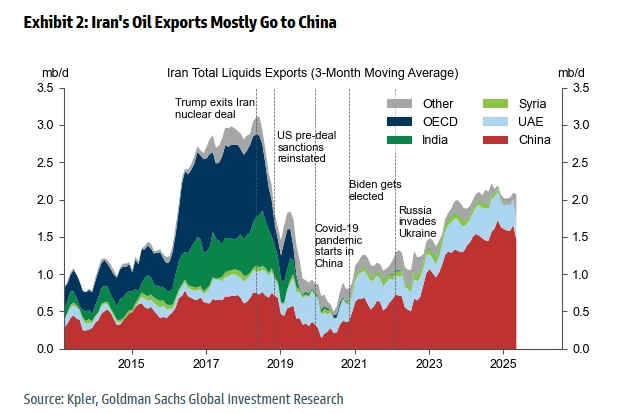
So here’s an idea: for every ship they mine, for every tanker they hit, for every missile they send at a Fujairah bypass terminal, seize their ships. Not one for one. Ten for one. Every Iranian flagged vessel on the planet is already being tracked. Park the carriers, interdict the tankers. Seize the assets. Then sell their oil. In DOLLARS.
Keep bombing.
Iran gets to play the chokepoint game right up until they realize that the Rimland power they’re poking controls the rest of the ocean. And they’ve already hardened the GCC countries against them by attacking Kuwaiti, Emirati, and Saudi infrastructure. Those were supposed to be neutral parties. Now they’re collateral damage. Every drone Iran sends at a UAE oil field is another country that has no choice but to join the coalition whether the Europeans show up or not.
The real trap is letting the Heartland framing dominate the conversation. Ray sees this as Suez 2.0 because he’s pattern matching to empires that lost control of chokepoints by failing to project power INTO them. But the US doesn’t need to project power into Hormuz. It needs to project power around it. Which is what a navy and all those planes are for. Which is what the Rimland is actually good at. The game theory here isn’t ‘who controls the strait,’ it’s ‘who controls the sea,’ and that one’s not even close.
There’s also a second front that nobody pricing the ‘end of the American empire’ seems to have noticed. Half the reason we are in this mess. This regime just killed somewhere between 7,000 and 36,000 of its own citizens two months ago to stay in power. The largest uprising since 1979, across all 31 provinces, over 200 cities. The only reason it worked was because they turned off the internet. A near-total blackout starting January 8th that cut coordination between protesters and hid the massacres from the outside world. Security forces trapped people in bazaars and set them on fire. Shot wounded survivors in hospitals. Executed people who tried to surrender. Brutal stuff.
The 40-day mourning period is coming, and historically in Iran, that’s when the next wave starts.
The IRGC is the same force doing both jobs. Suppressing a domestic population that hates them AND fighting a naval/missile war against the US and Israel. Every unit firing at tankers in Hormuz is a unit not available to shoot protesters in Tehran. Every missile aimed at a Fujairah terminal is a missile not aimed at its own people.
So flood the country with Starlinks. Tens of thousands of terminals are already smuggled in from the 2022 protests, and they’re the only reason any information gets out of Iran during blackouts. Use airpower to scale that by 10x.
Fund it with the proceeds from seized Iranian tankers if you want to be poetic about it. And if the Kurds aren’t coming to the rescue and the regime is slaughtering unarmed civilians in the streets, then airdrop the people guns.
If the IRGC is going to wage war on its own population, the population should at least have the means to fight back. You can fight a war abroad or a revolution at home. Pick one.
Friend Oil vs Enemy Oil
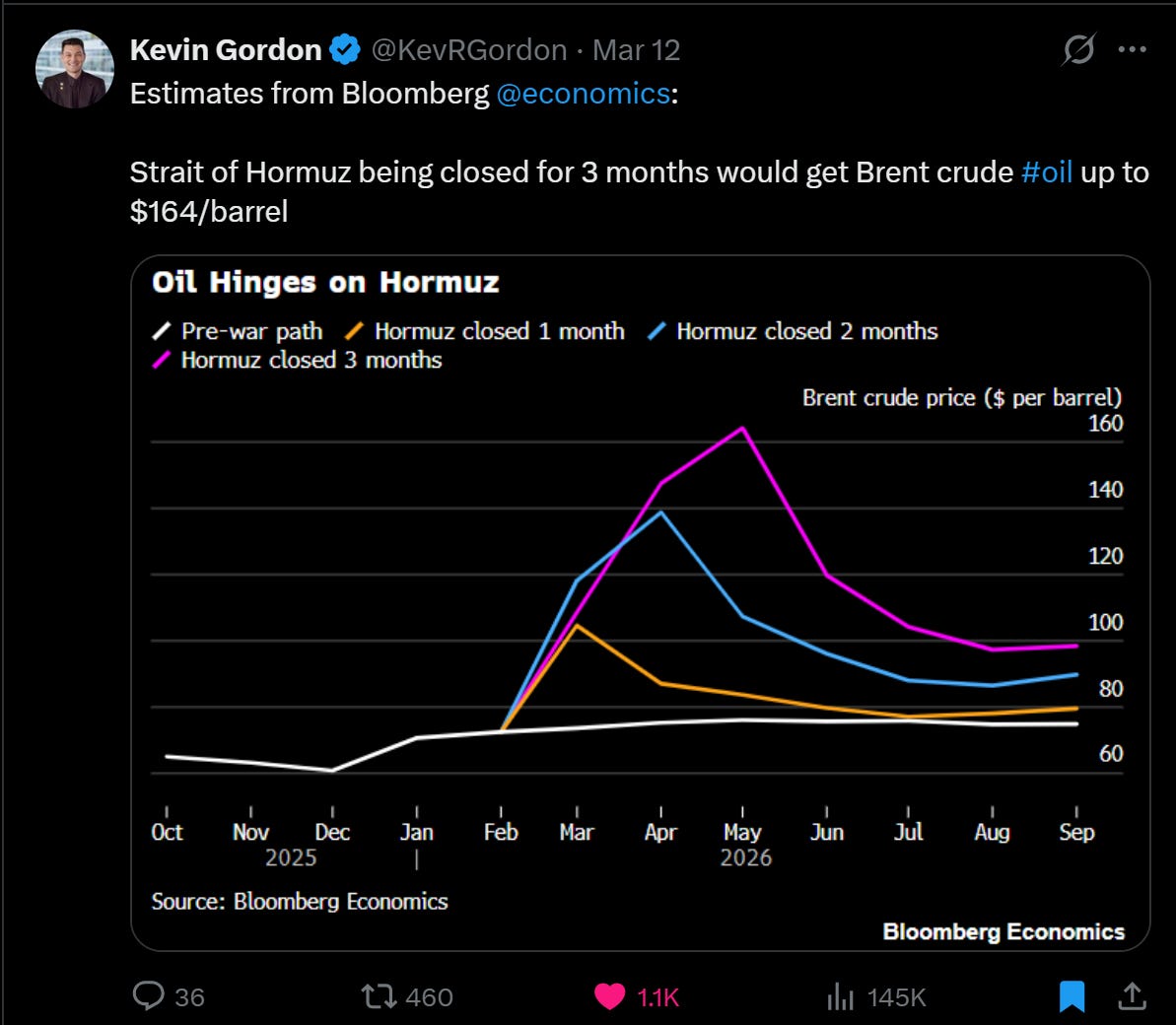
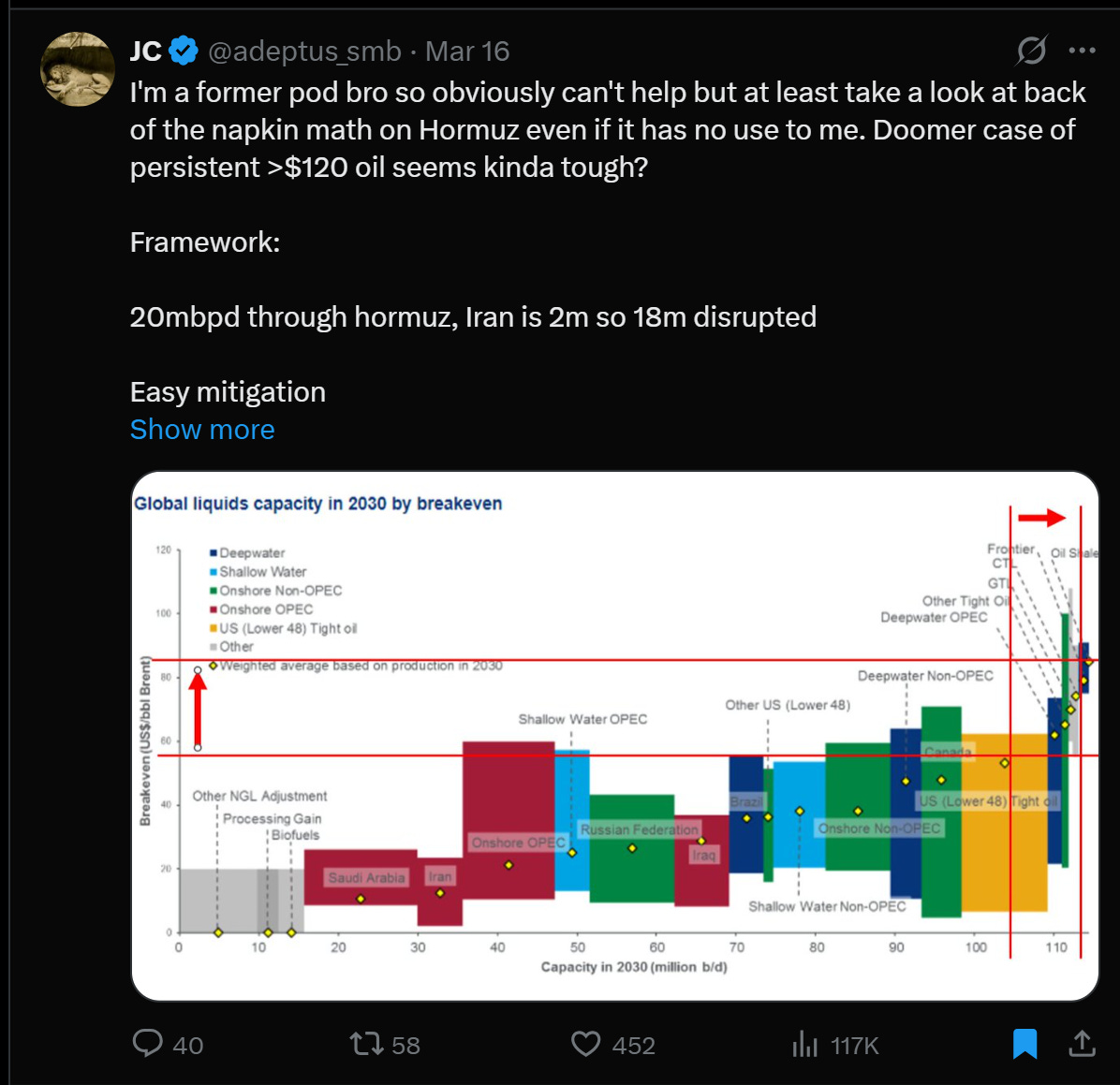
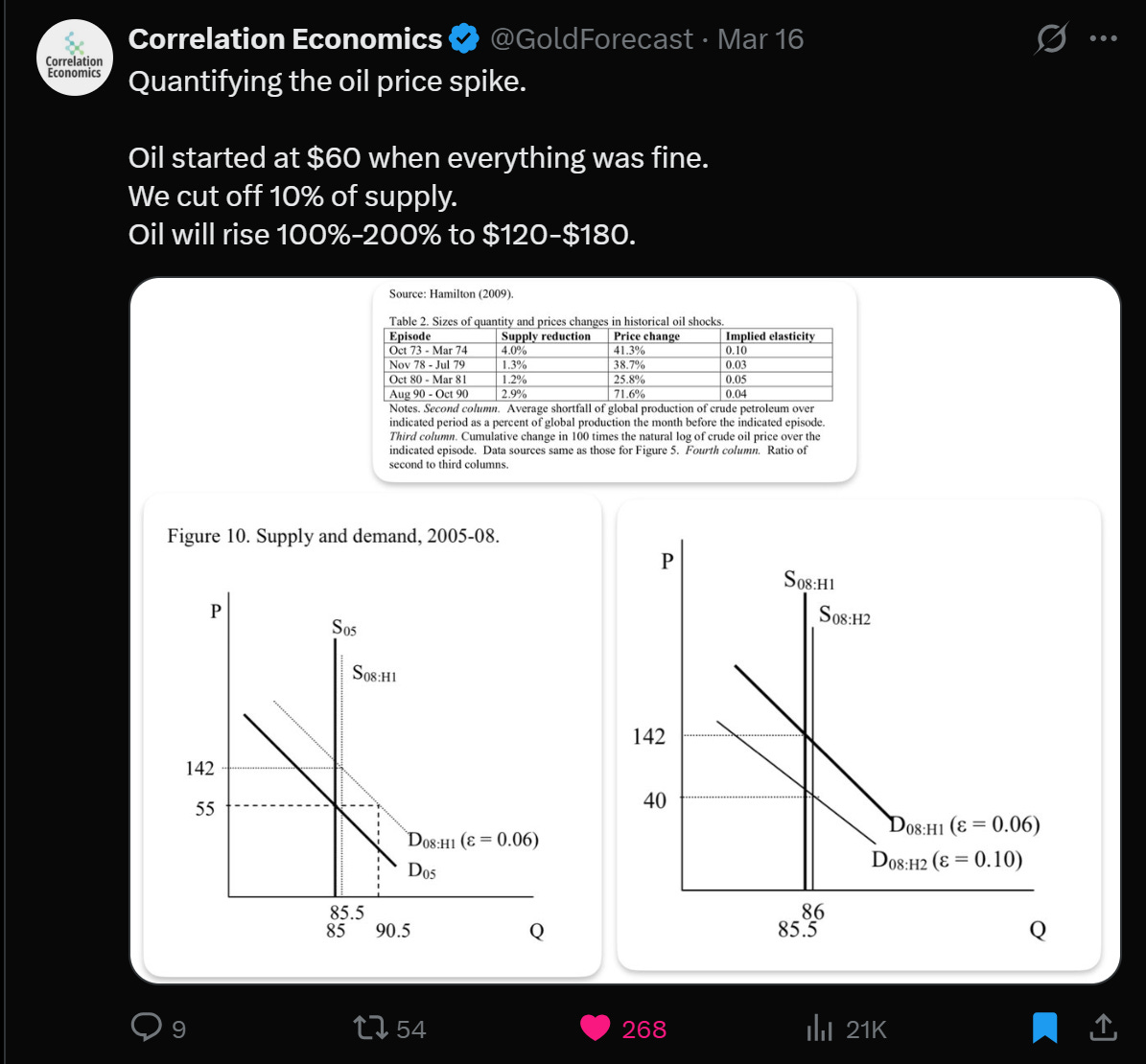
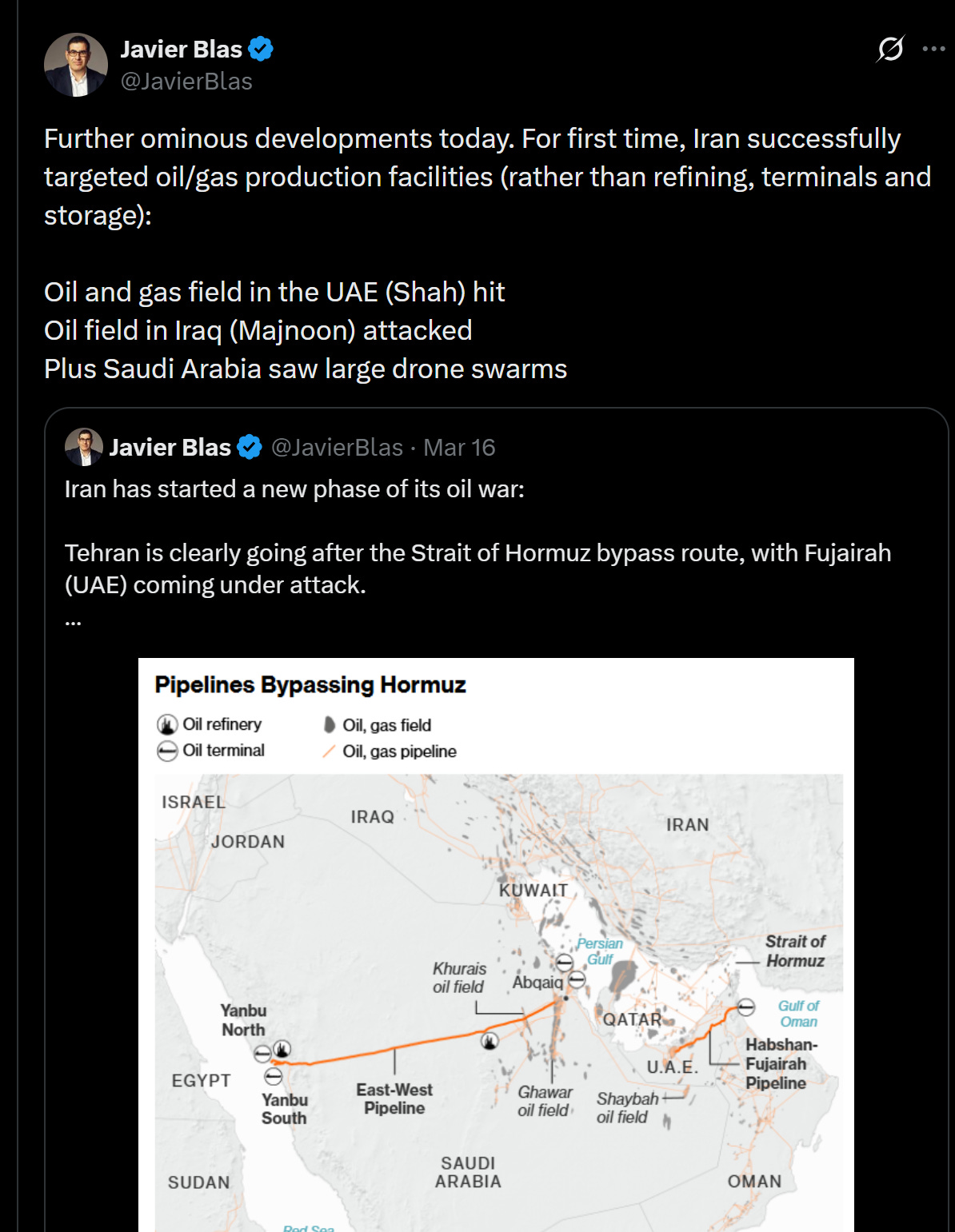
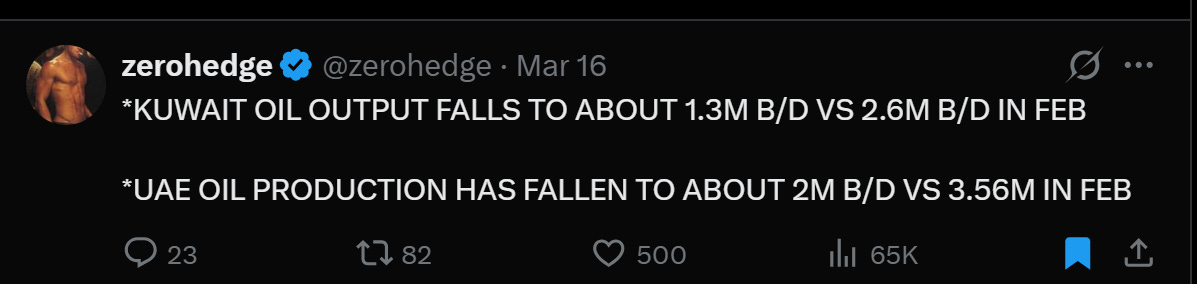
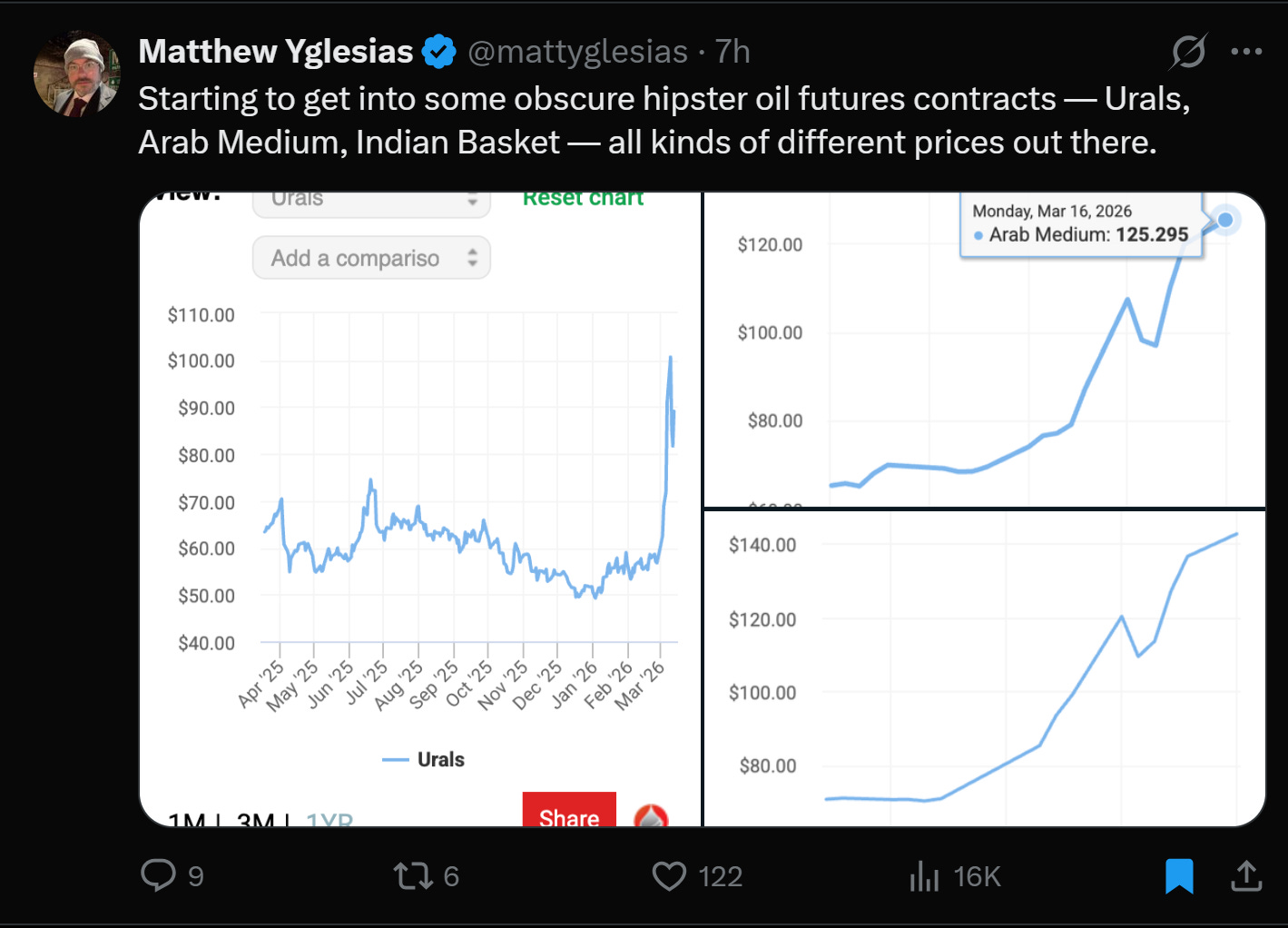
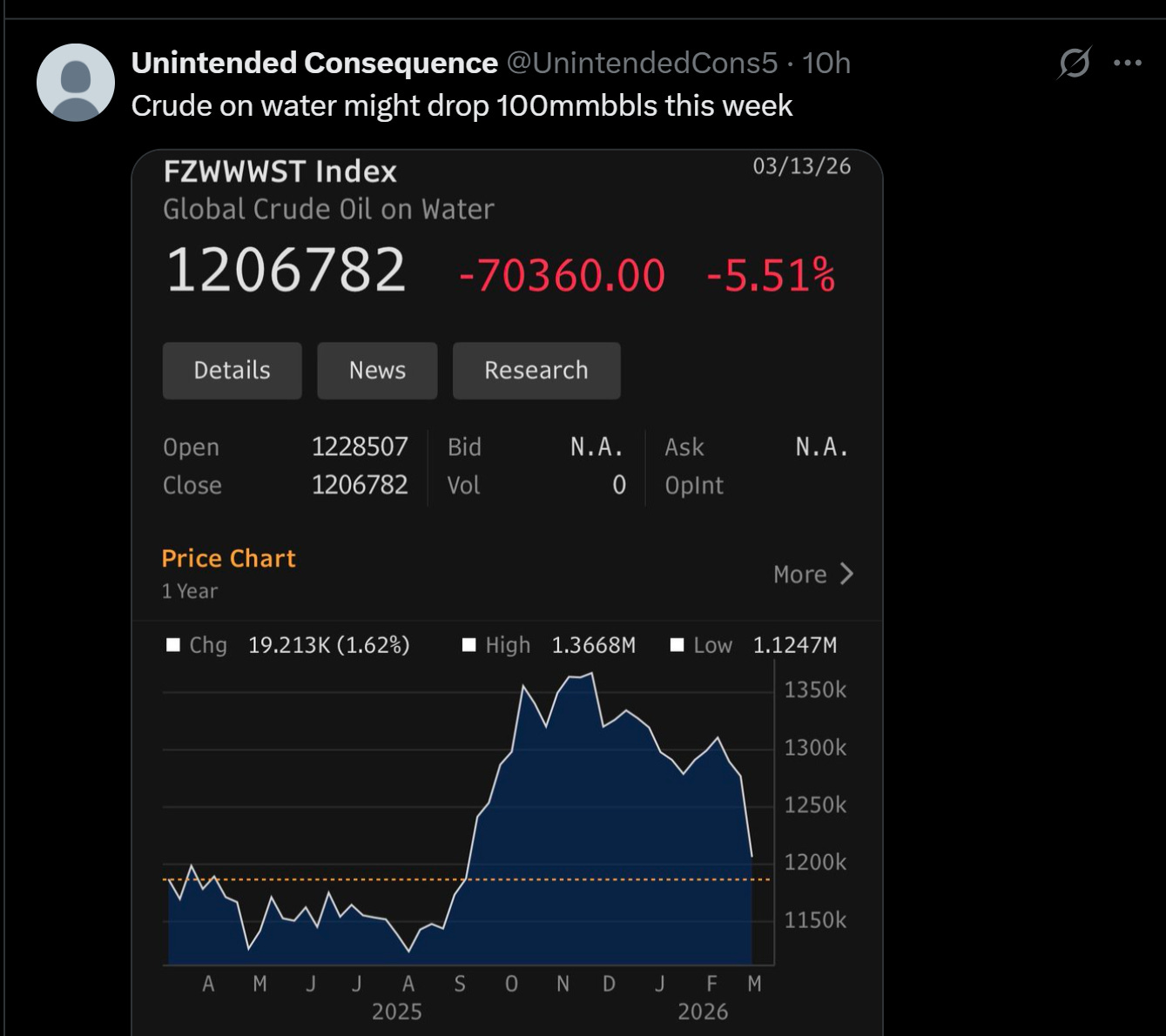
I’m not sure what happened to the front end of the western oil market (I would not be surprised if some policymakers intervened, selling spot to buy forward, and fulfilling their shorts with flows coming from the strategic stockpiles, seems like a good trade and decent policy), but it seems clear that the abstraction embedded in the question ‘what’s the price of oil’ is yet again being begged into a second question of ‘which one.’
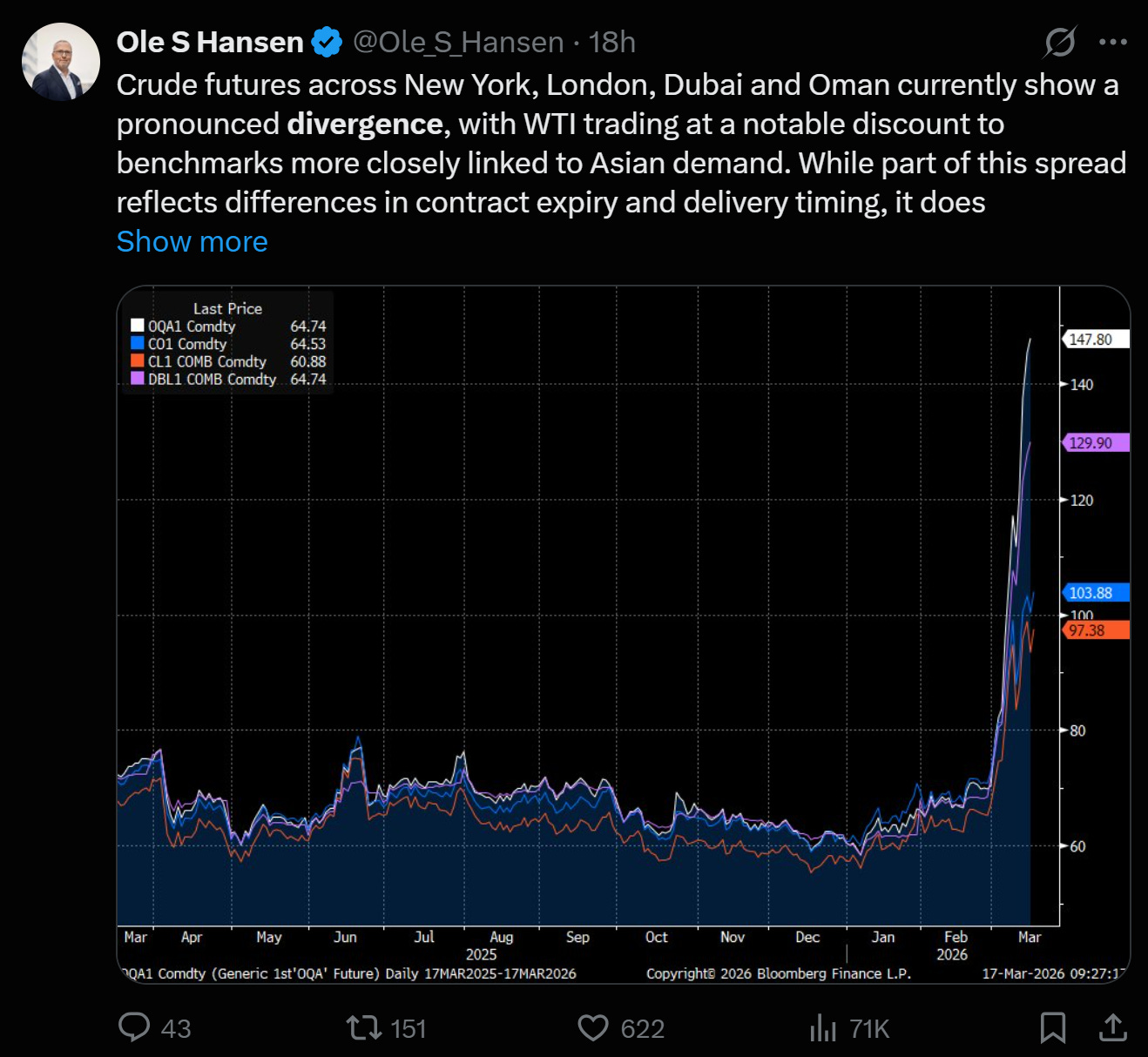
Our call last week that ‘we don’t have confidence in the front of the curve, but the back of the curve is too cheap’ was borne out well (look at me ma, I still got a bit of that oil punter left in me).
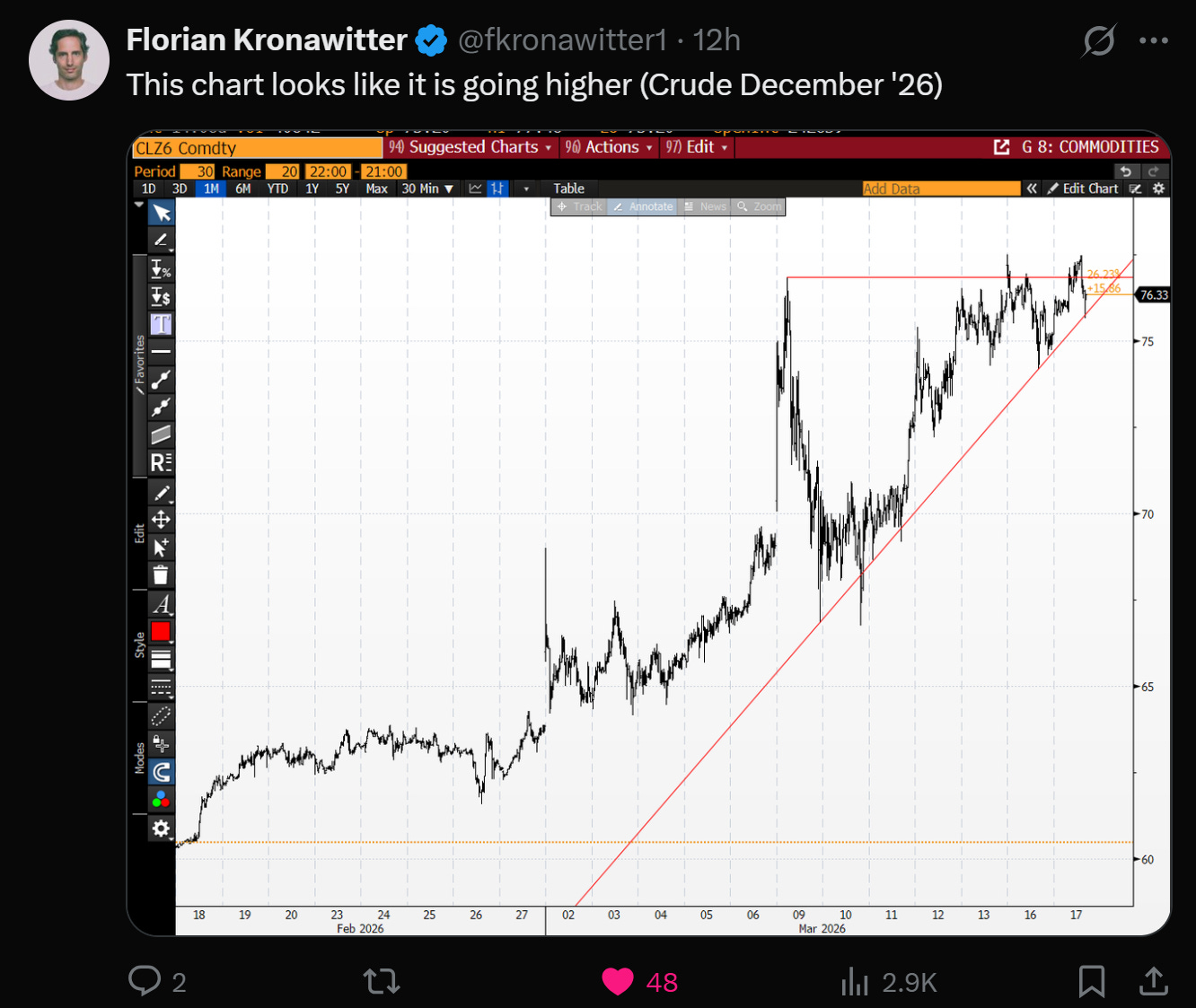
Which is a function of folks kind of internalizing that a) there don’t really seem to be a lot of off ramps, b) this isn’t the kind of thing that Trump can just fiat his way out of, and c) Iran has more cards to play than maybe a lot of people thought.
Why the Macro Is Eating Everyone’s Portfolio
Ok, so what does all this mean for markets.
The funny thing about being a macro speculator is it’s simultaneously the easiest and the hardest job in the world.
The easiest because the effective barriers to entry are zero.
The hardest because you are explicitly trying to deal with the markets at the highest level, which means there’s always some new bit of information or data that you haven’t paid attention to, which can (all of a sudden) become a ‘macro risk.’
Hormuz. Liberation Day. DeepSeek. The yen carry unwind. SVB. COVID.The list goes on.
The funny thing about this is that most professional investors take pains to market themselves in opposition to the macro.
“We run beta neutral.” “We chase absolute returns.” “We don’t make bets on politics.”
While there are times, usually around 2-4 times a year, where ‘the macro’ becomes so important in determining market outcomes that not only does it start to drive their portfolio, but it basically makes clear that, yes, after all there was a lot of macro risk embedded in their portfolio.
This is where things like ‘alpha vs beta’ or ‘risk adjusted returns’ came from, since a lot of equity and bond investors were (stealthily) embedding more macro leverage or risk in their portfolios than they admitted.
For example, if you own a basket of 45 vol tech stocks with a high correlation to the market, you might not actually be ‘hedged’ even when you ‘hedge your market risk’ by selling SPUs 1-1 against your portfolio. If your book goes up 3% every time the market goes up 1%, well you are kind of 2x levered the market, even if notionally, you are hedged.
This kind of experience (oopsie, we had more beta than we thought!) then led allocators to start decomposing the returns of their managers into factors. There’s nothing a data scientist with no investing acumen loves more than taking a time series of your returns and breaking it into a million tiny pieces, of more and more degrees of statistical sophistication:
“We don’t use correlations to the market, we use PCA decomposition where the first PC is ‘market risk’ and you have too much.”
“Oh ok.”
This then kind of bled into the funds that manage a bunch of managers (pod shops and fund of funds) who then started using these tools not only to understand their risk, but ‘control it.’
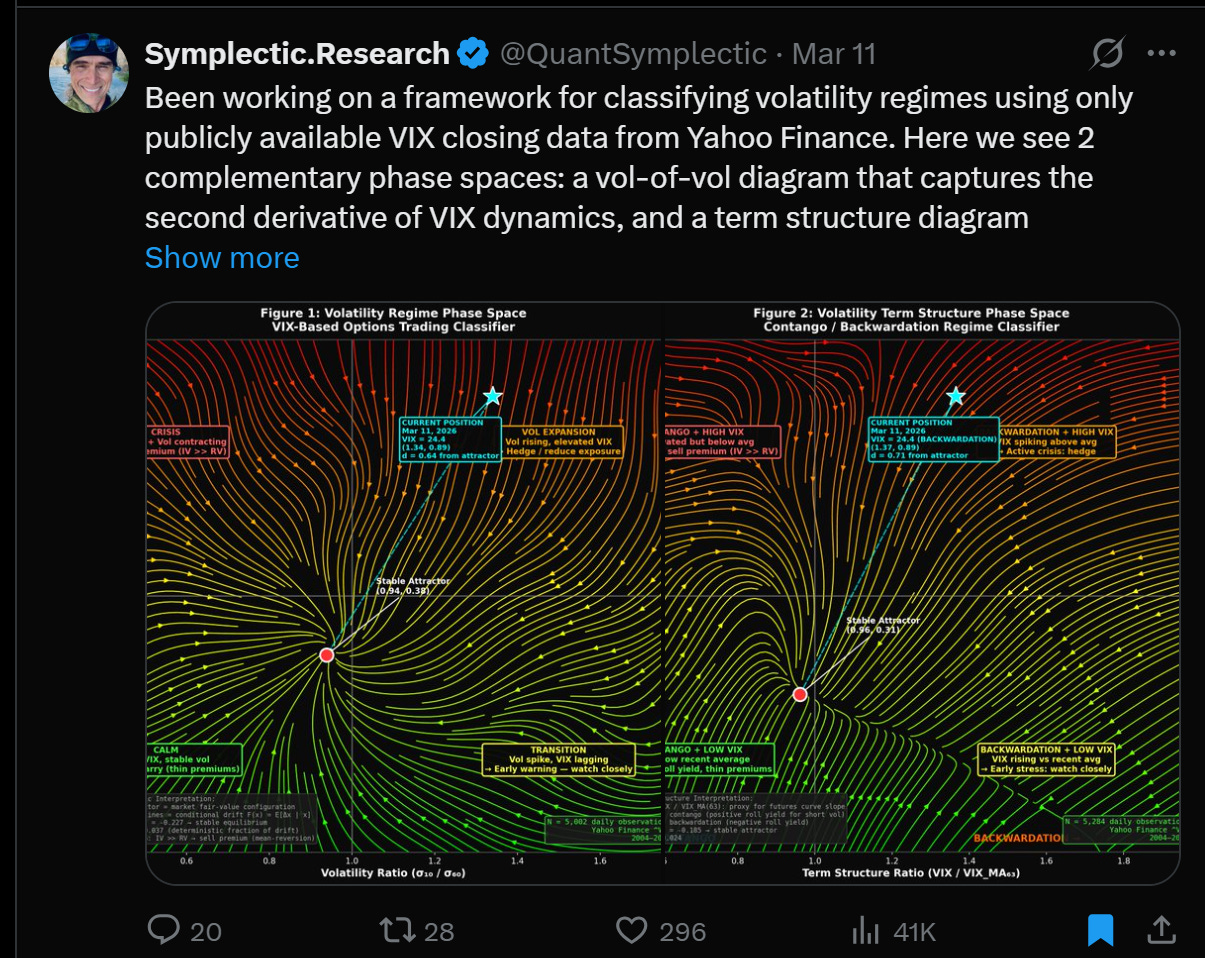
Which makes for great risk adjusted returns, but also ends up with stretches like the last couple of weeks, where a lot of these managers all end up looking kind of similar.
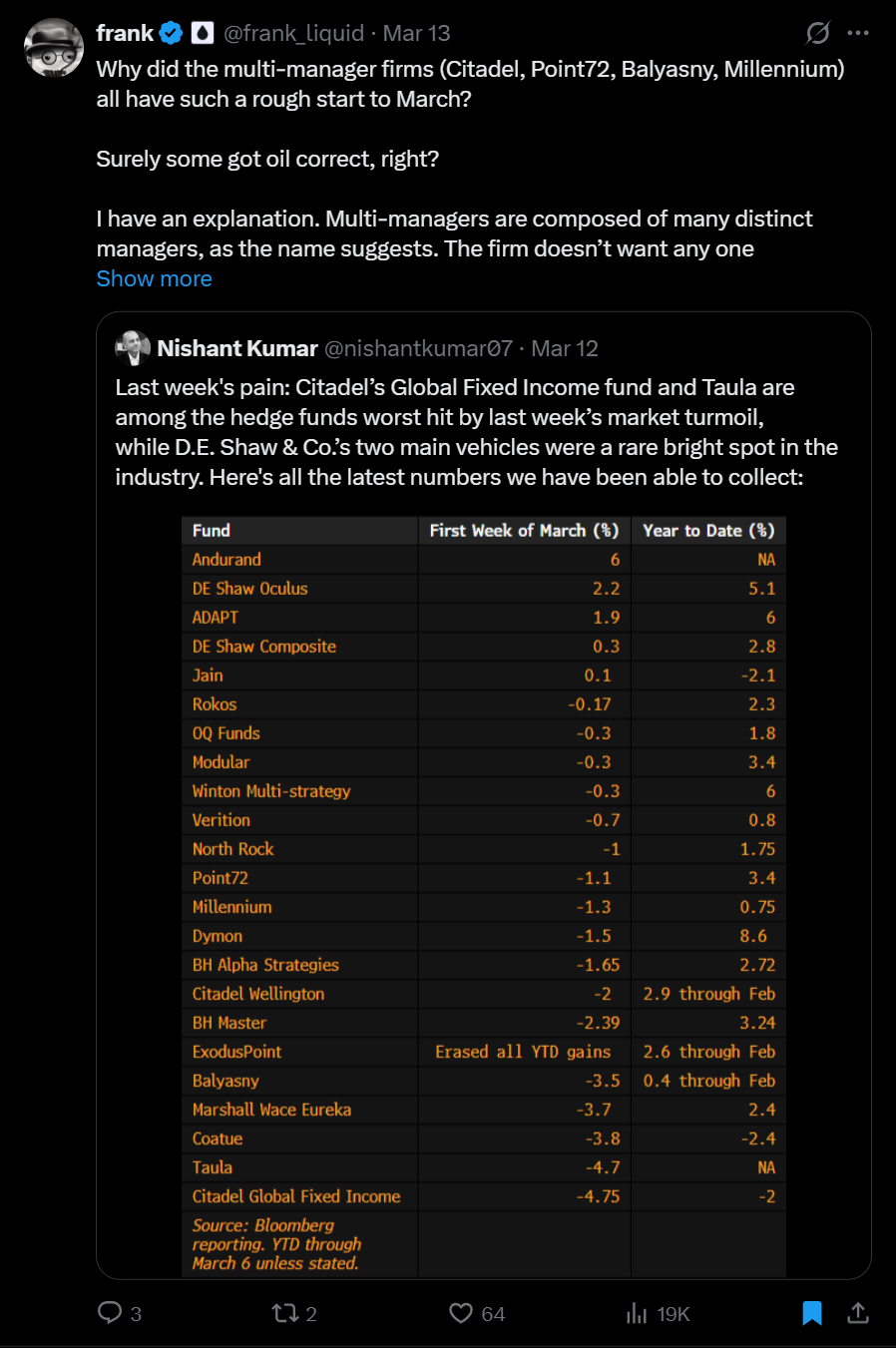
Why was the beginning of March so tough for folks? Well, in part because a lot of them weren’t positioned for the war (not that you would expect them to be), and in part just due to the kind of volatility we saw at the beginning of last week (was it last week? wow feels like one of those time warps where time slows down and speeds up at the same time).
See, when you are managing a lot of managers, often with ‘tight stops’ (aka risk controls which mechanically reduce risk or even fire them when they lose X%), you kind of guarantee that when you get big market moves, someone is going to hit their stop, and ‘blow out.’ Meaning, in some sense, a lot of these firms are not only chasing alpha, but also ‘short volatility’ (though in a way where they are only short the first x% of the move, so maybe modeled by being short ‘iron condors’ where they make a yield when things don’t move too much, and then lose money, up to a point, when things go wacky. Which if you can get the transaction costs right, is actually a pretty good strategy.
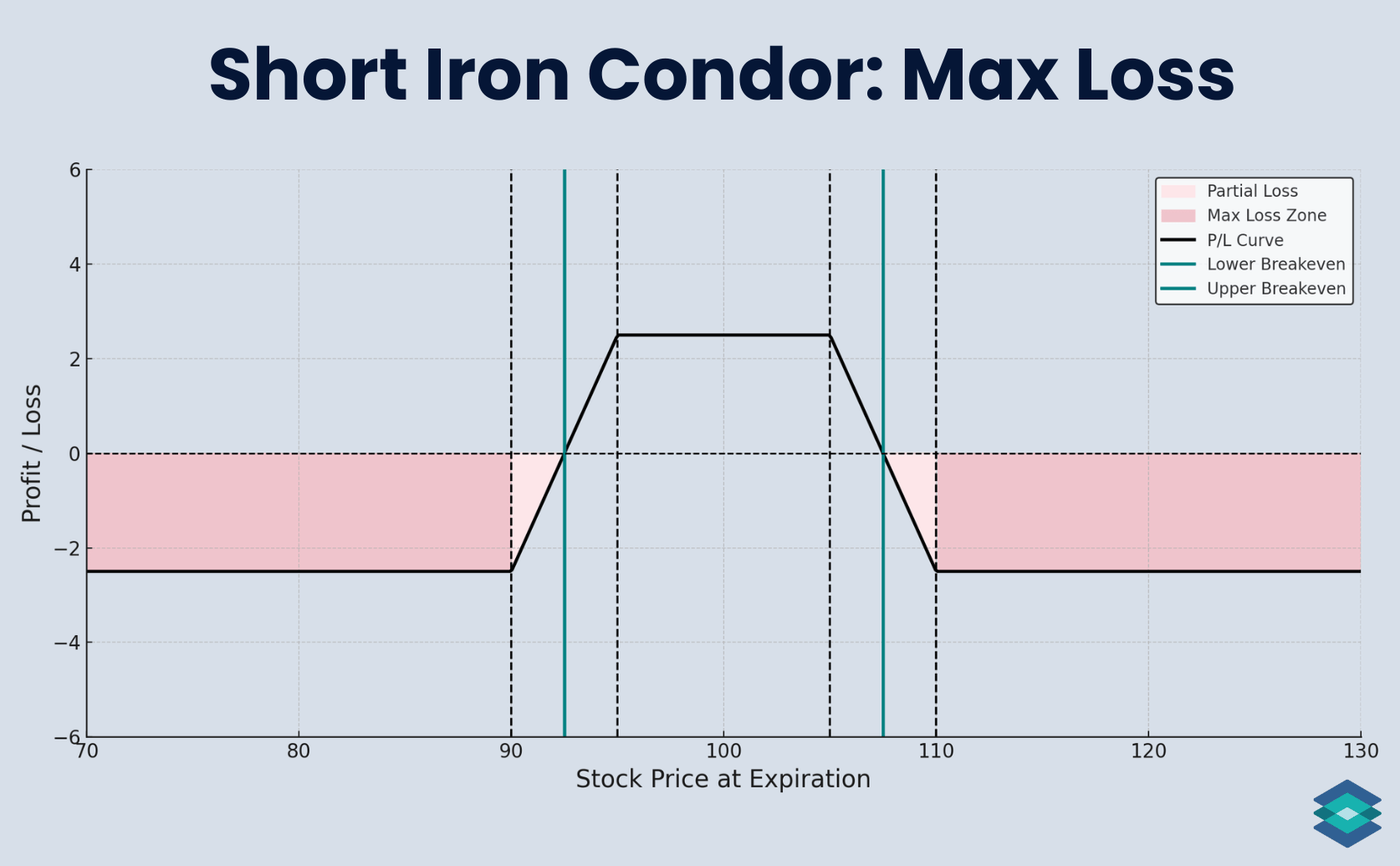
Better than being outright short vol, which at this point you don’t need little ol Campbell to tell you is a really dumb idea (if you aren’t just in it for a quick buck, as most of these managers implicitly or explicitly are, on a long enough time horizon all short vol strategies go to 0).
There’s no ex-macro purists in a war for oil, as they say.
The Impact on AI
But the war doesn’t just threaten your oil book. It threatens the thing everyone is actually long, which is the acceleration itself.
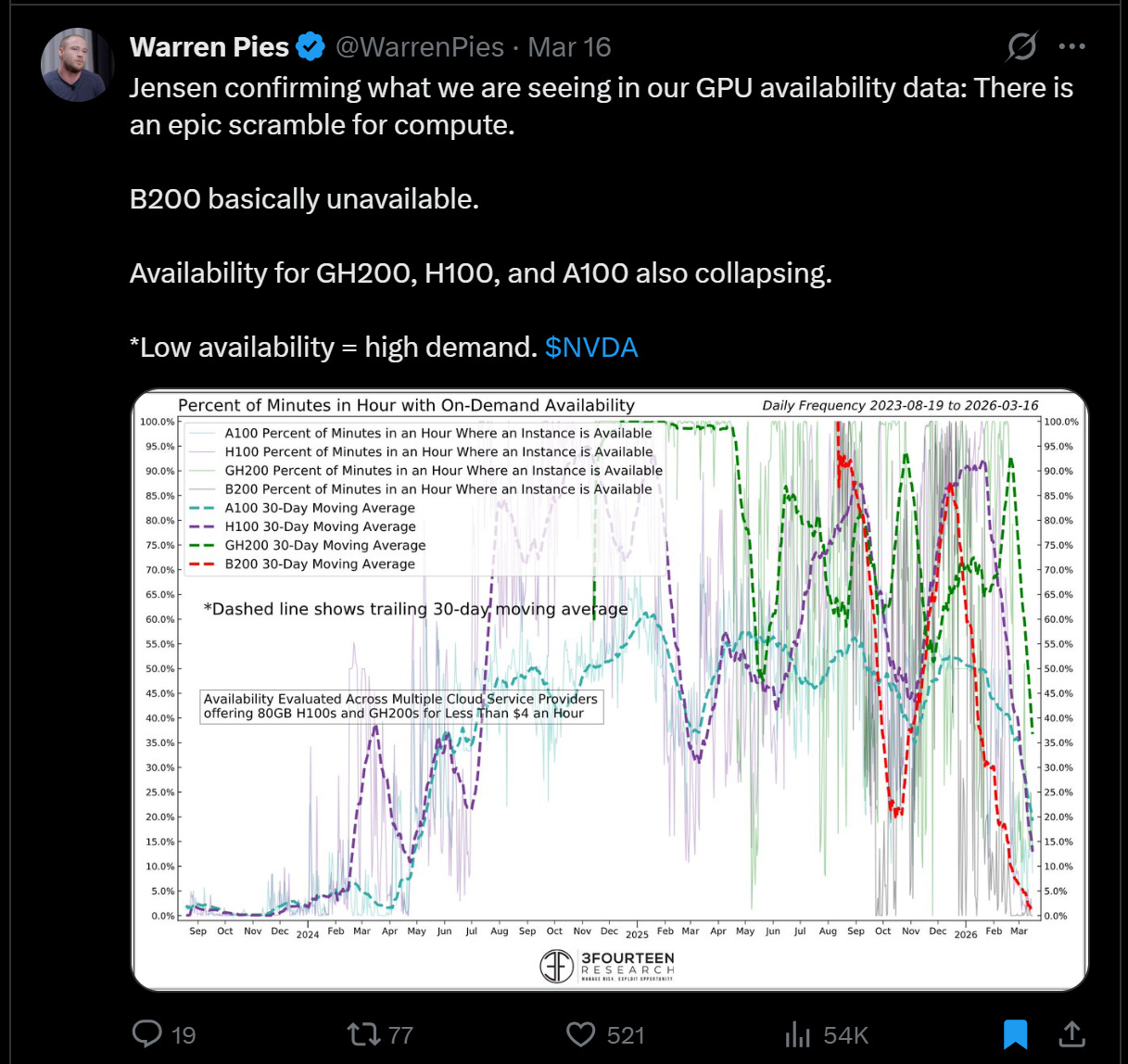
Look, let me be brief. At this point we know we’re in the acceleration, and I still maintain that a) the models aren’t getting exponentially more intelligent (scaling laws are holding, you still need exponentially more compute/energy to get linear increases in intelligence, aka The S Curve Is Here) but they are getting exponentially more useful.
Why?
Well, if you are familiar with my previous screeds about AI you know that my single biggest gripe isn’t with doomers’ assumptions about the path of intelligence (though for all intents and purposes the halting problem and Gödel’s incompleteness theorems appear to be holding, lol) but rather the logical fallacy at the heart of every doomer fever dream:
Intelligence = Power.

Again, all the books, all the articles, the NGOs, the cults, the fanfics, the conferences, the protests, almost all of them are fueled by what is essentially a ‘revenge of the nerds’ fever dream. “I was the smartest kid in high school. I wasn't the most powerful. But one day, if I build something smart enough, surely that will fix it.”
At the heart of this fallacy is something every chad knows: the path to power in high school (or college, or say the ballot box) isn’t intelligence. It’s not even muscles or external validation. At least in high school (and elections) the path to power comes from popularity. It comes from choice. The choice of others to provide you power.
Social power and physical power have been disconnected pretty much since our emergence from the primordial caves, and yes, the transformation has meant that the returns to intelligence are much much higher than when the ‘alpha’ was determined by the guy with the biggest club. But even then, pretty much as soon as we formed bands or tribes, it was ‘who had the most bros.’ Flash forward a couple of million years and maybe it’s not who has the most bros (though as we’re seeing in times of conflict this still matters) but the average person’s path to power comes from the choice of others to yield them power, by choosing to buy their app.
A lot of people bemoan Elon’s path to power, but you have to admit, if no one liked his app, or his car, or his rockets, then he’s not worth much money (something he learned last year, when his attempts to wield political power inevitably led to a backlash on the popularity, and hence profitability, of his car company).
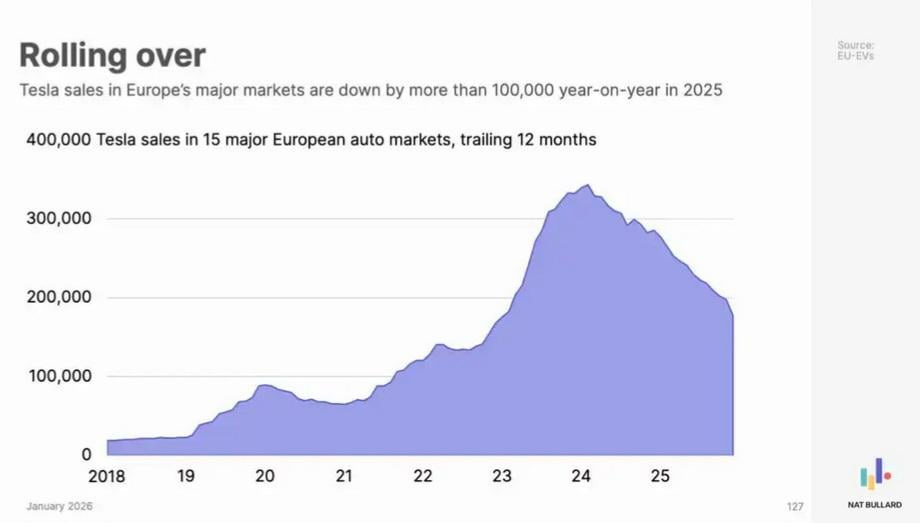
Anyway, so if the models aren’t THAT much more intelligent than they were 4 months ago, why are all the lines going up and to the right?
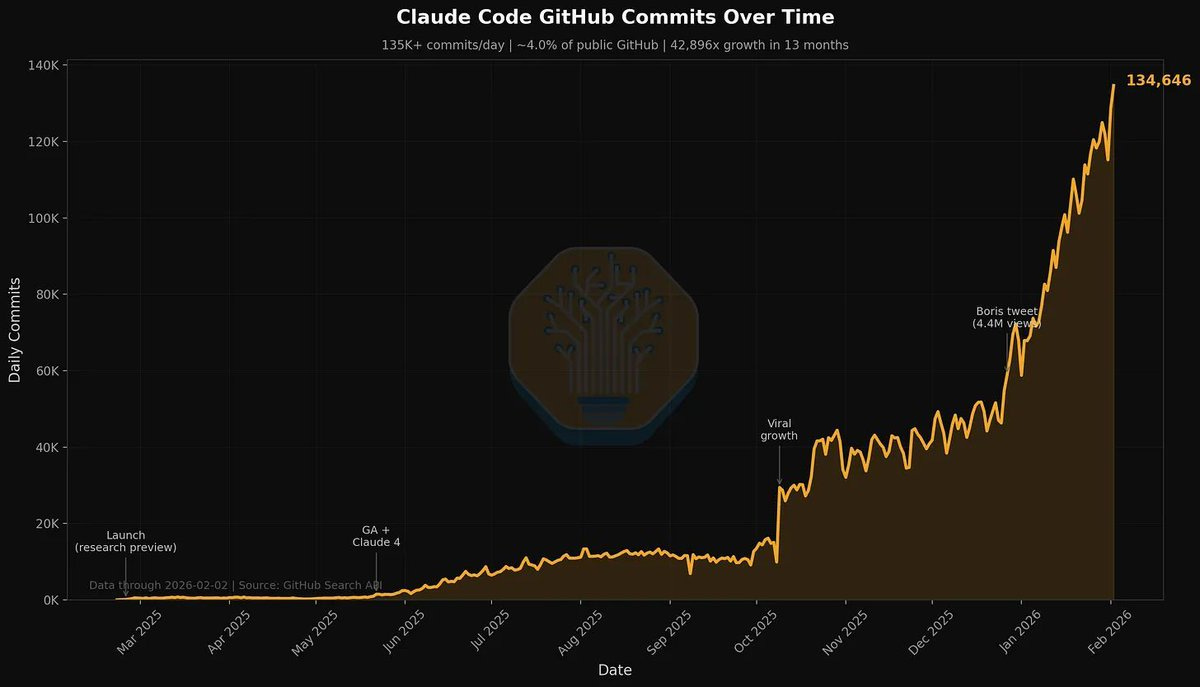
Well, it’s simple. The combination of a) they got to the point where the hallucinations/intelligence got ‘good enough to use’ and b) they were given power.
The thing you need to realize about Claude Code, or Codex, OpenClaw, or the litany of me-too copycats is that the reason they are impactful isn’t because they are that much smarter than the other bots, it’s because the ‘orchestration environment’ is much much much more powerful.
This is what tech people mean when they say these bots have more ‘agency.’
Agency = power
There is just a massive, massive difference in the amount of damage (in the good sense and a bad sense) that an LLM can do when it’s running inside your computer with ‘dangerously skip permissions’ on than when it’s talking to you through a very narrow and constrained set of text-based, web-hosted interfaces (someone page Alan Kay and Bret Victor!).
The richness of the experience, and the amount of POWER you have given the brain in a box, is something like 10 orders of magnitude more. When it’s just a webapp chatting to you from a server farm, the worst thing a chatbot can do to you is call you a name and hurt your feelings (or maybe retain some embarrassing or incriminating or non-compliant piece of information, which isn’t nothing after all).
Compare that to giving that bot ROOT ACCESS TO YOUR COMPUTER, or read/write access to your emails or text messages or bank accounts.
The models haven’t gotten 100x smarter in the past quarter but they have gotten 100x more powerful, with just enough reliability to be worth it (notwithstanding the occasional ‘omg it formatted my hard drive’ or ‘whoa it texted my wife at 8am under my account’).
So again again again. The next time a doomer lectures you about ‘instrumental convergence,’ remember: the robots didn’t get more powerful because they ‘inevitably sought power to pursue a misaligned objective function.’ They got more powerful because someone gave them a bunch of SSH keys and a ill-defined prompt.
Why does this matter? Why did this rant show up in the middle of a war piece?
Because it explains what’s happening to the thing everyone is actually long.
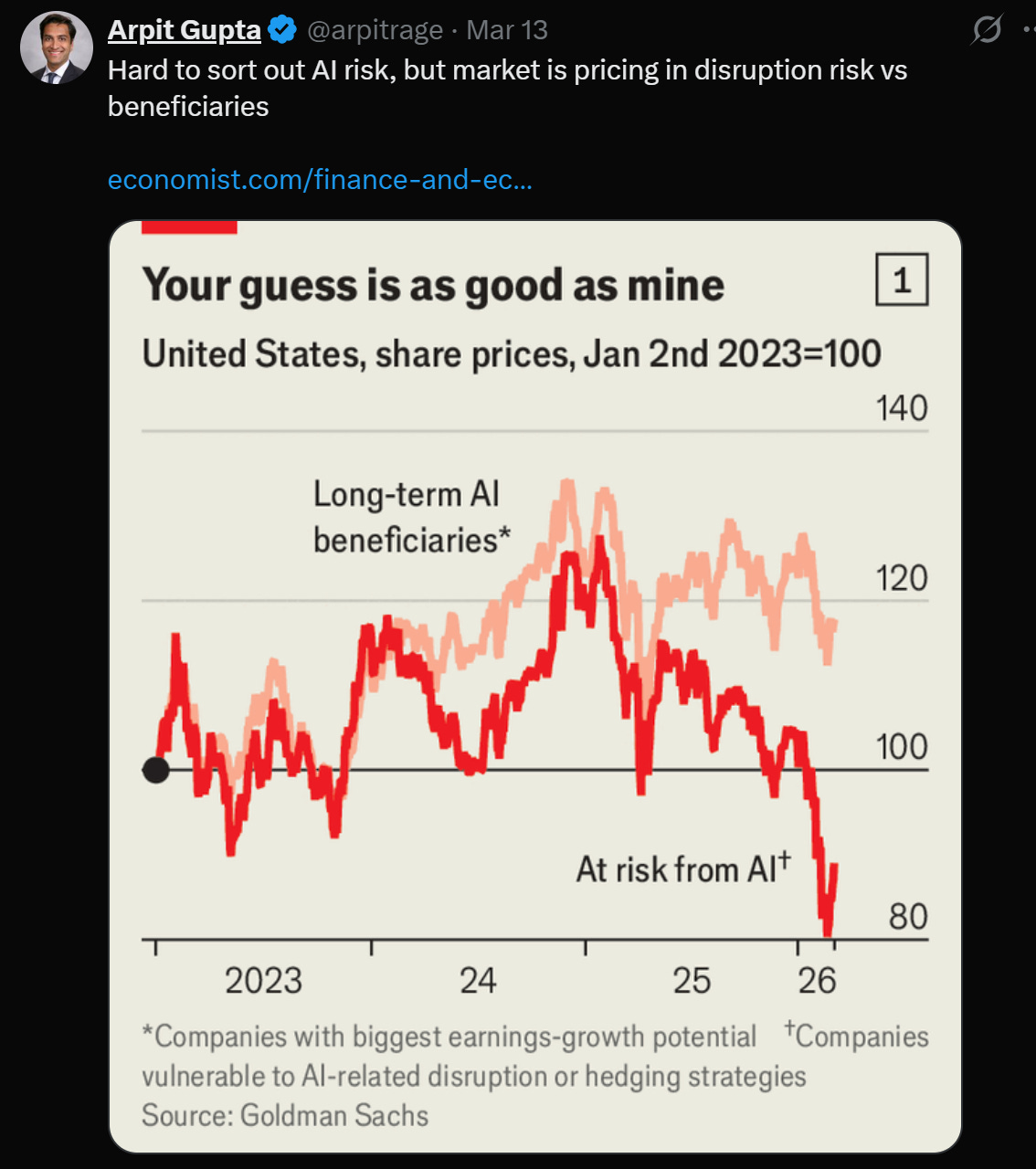
See, oil just went up a LOT.
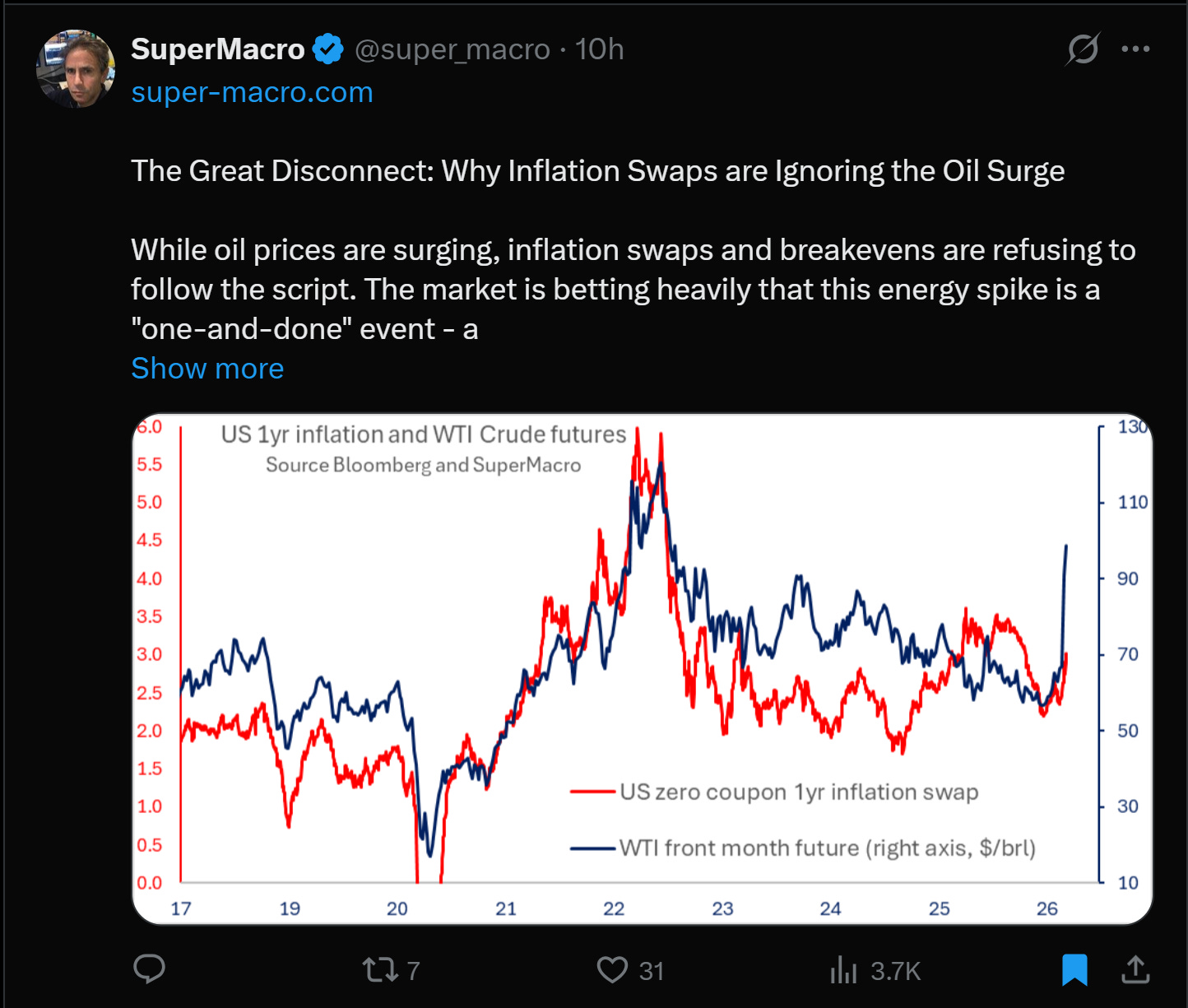
Even if peace breaks out tomorrow and oil (and all the other stuff coming out of Hormuz, like fertilizer components, and sulfur and helium) comes gushing back through, we have some inflation coming down the pipe.
Maybe more than breakeven inflation is pricing in (though remember, looking at the front month when the curve is this backwardated is the wrong indicator to peg to breakeven inflation!), and definitely more than folks are pricing into the ancillary markets which will be gummed up with supply chain problems for the next 3 months. This is if things go back to ‘normal’ tomorrow.
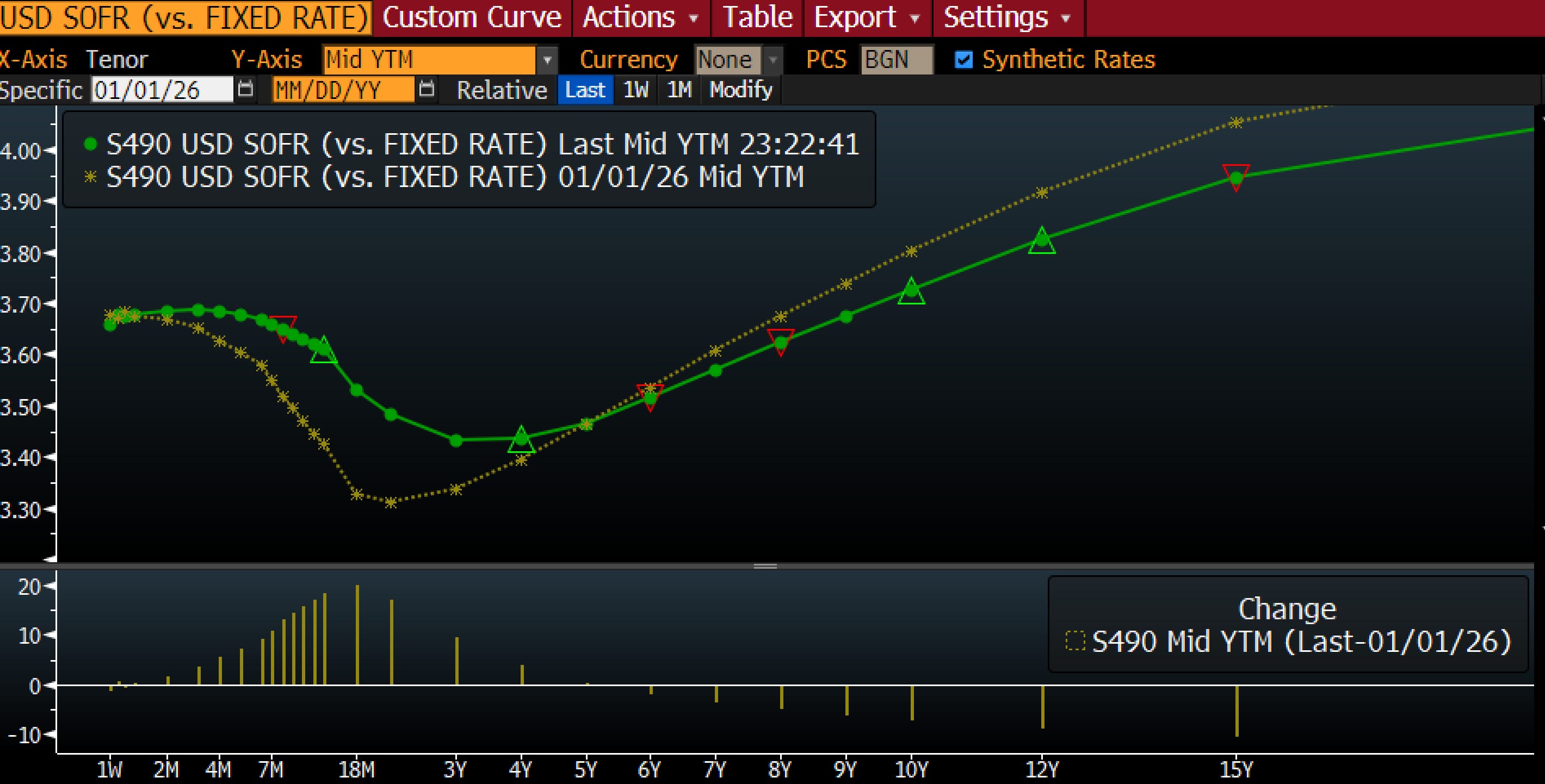
Which explains why the bond market went from pricing in a good deal of easing to pricing in a tiny bit of tightening. Even if these supply chain problems wreak havoc on growth, the Fed pretty much can’t come to the rescue.
(Keep in mind the Fed’s reaction function should also be a function of how this increase in energy cost is paid for. As a new friend recently pointed out, the inflationary impact is very different if consumers pay for higher gas by lower spending elsewhere vs by levering up through lowering savings rates. The former is a deflationary impact on all the other stuff, the latter would probably force the Fed to tighten to kill the resulting inflation.)
So What Do You Do
Sooooooo the implication for folks’ portfolios is currently a weird one.
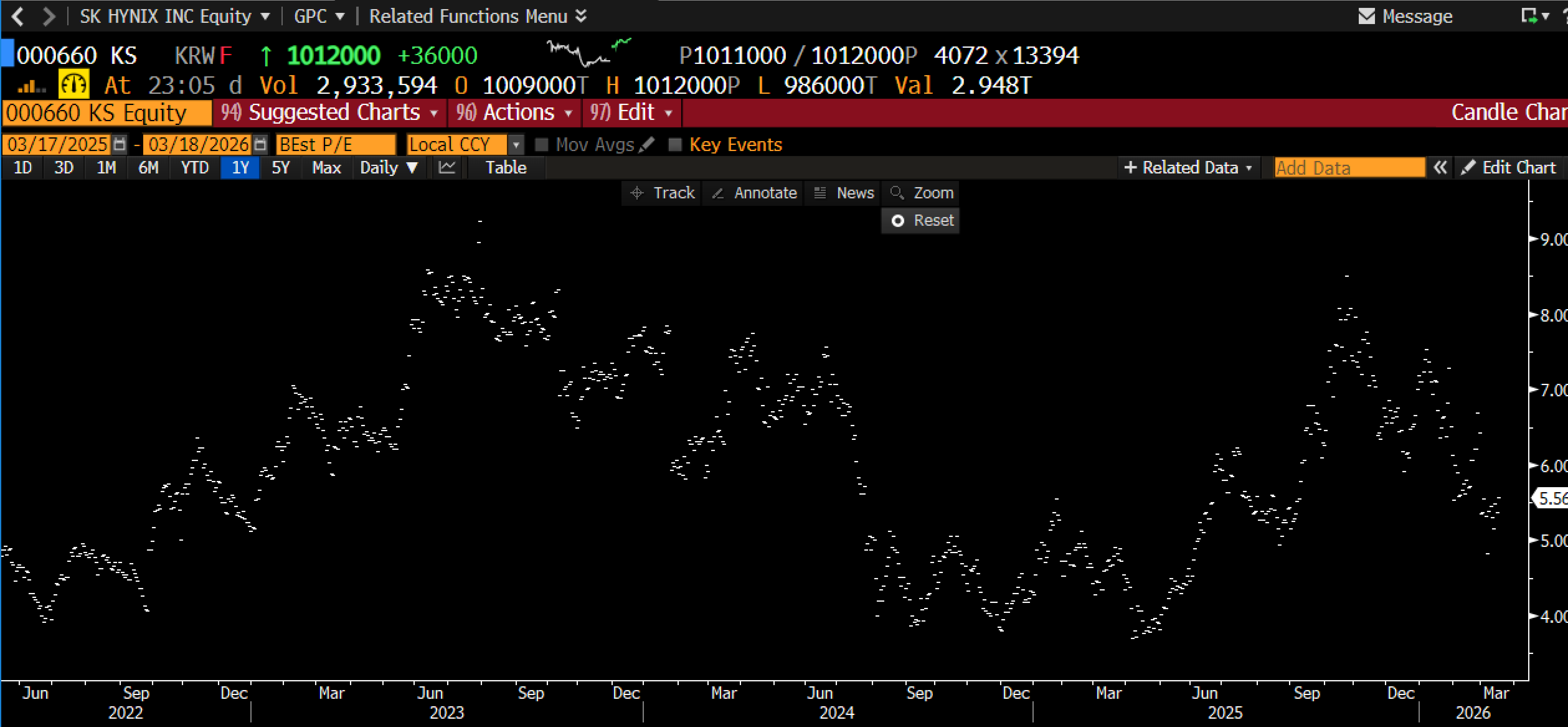
IF we get peace ASAP (which seems less and less likely every day), oil comes back down, the inflation comes out of the system and sure there’s some supply chaos, but it’s basically off to the races, the Fed (and other developed world CBs) can shift to easing and all the bets on AI (which is probably pretty much everyone’s core bet at the moment — another ‘macro bet’ in stock picker’s clothing) will ride out the vol and pay off. Heck, SK Hynix is trading with a sub-6 PE!!!!
But, in a world where this is the beginning, where it’s the final battle, and will take weeks, months, or gasp, years to fully resolve, well that really sucks. Not only because it means we get energy inflation, which means tightening (ugh), but it also means other kinds of cost-push inflation (no helium means less chips, which means less data centers, which means less FLOPs, which means the cost of training and inference just went UP). It actually means a slower acceleration.
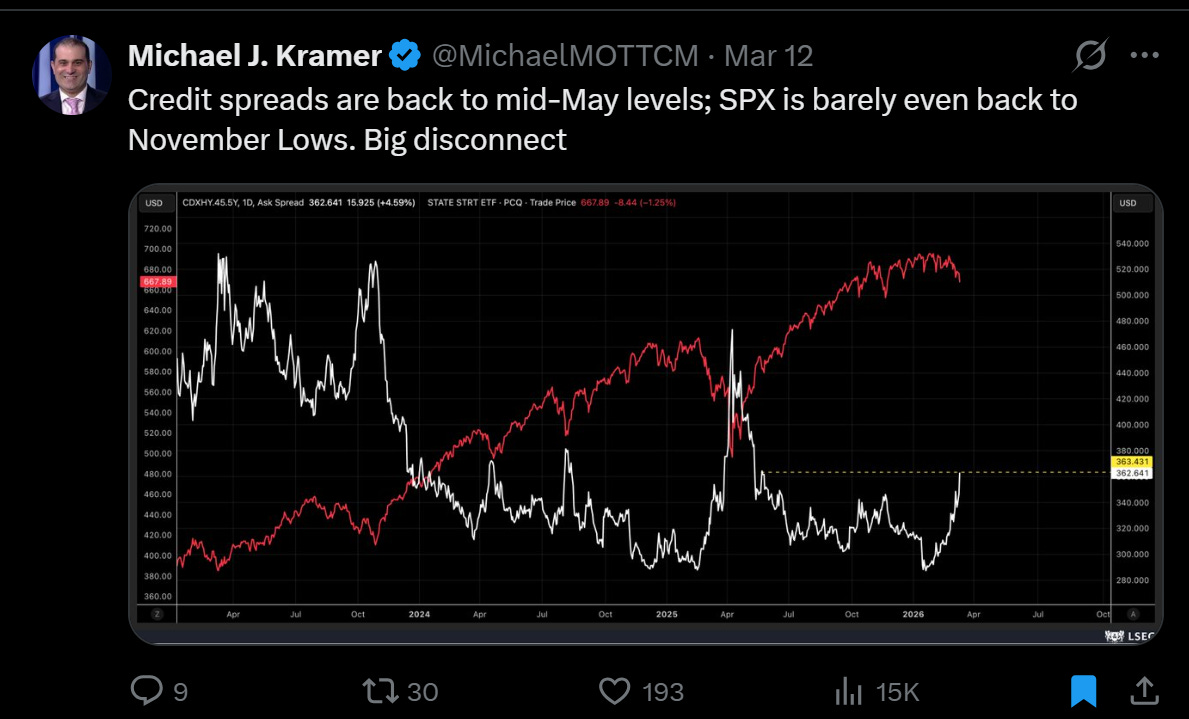
Which, if combined with any kind of credit problems (I’m still probably a bit early there folks, I’m usually early), means there’s a chance (a chance!), that the acceleration will be delayed not by the pace of capabilities, or even the power / latitude given to the models, but the very financing of the compute that makes the whole thing go vroom.
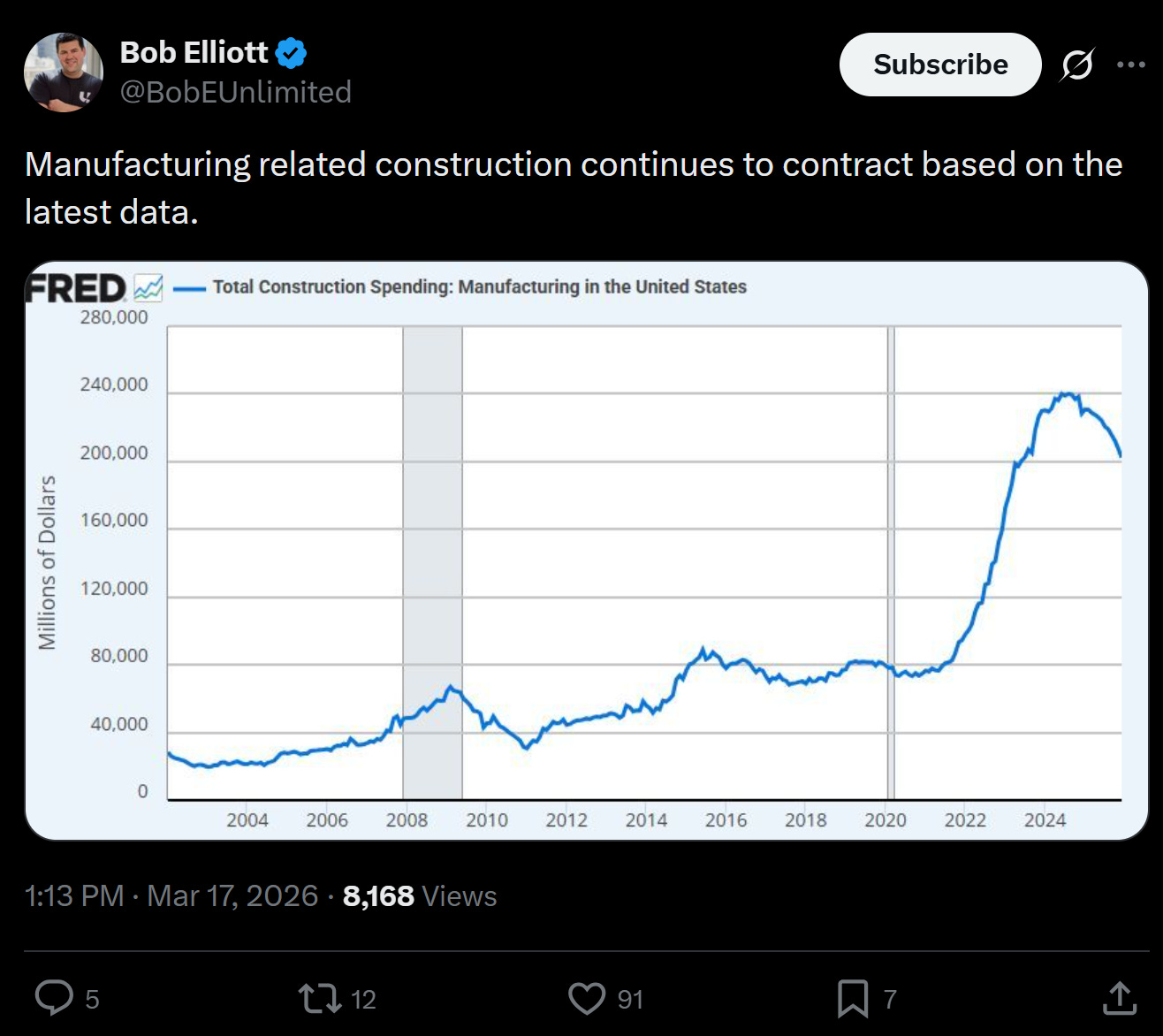
On the bright side, outside of the spend on compute and the investments in business process needed for ‘AI transformations,’ the acceleration is deflationary; it should lead to very serious productivity gains. But every day Hormuz is closed raises the prospect that those productivity gains come from firing the workers who don’t use AI, and giving more budget, more spend, and yes more power, to the workers who find a way to use it to become radically more productive than their peers. So that when the layoffs start, it’s clear where the fat to cut is.
If this is all super confusing, welcome to markets, welcome to macro.
The degree to which ‘everything is the same trade’ right now should give everyone pause.
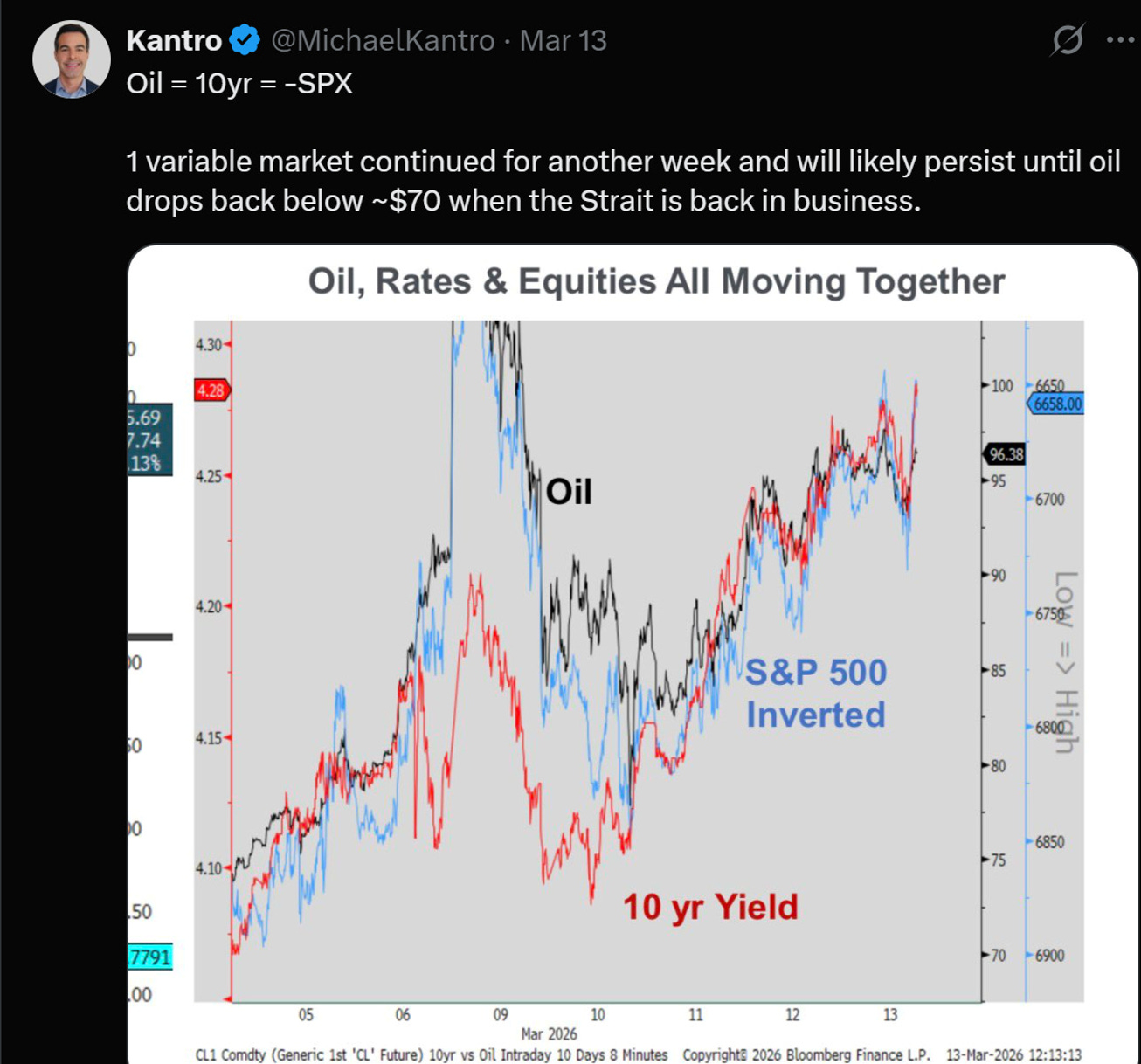
Rather than try to be the hero and call the top or bottom of the oil market (basically impossible), or try to perfectly hedge out all the war/oil risk (also impossible), the implication is simpler than that. Take down risk. Preserve your bullets for when things are actually clear. I see a lot of people right now going into hero mode or trying to craft the perfect hedge while options are expensive and correlations are deeply uncertain. That's not risk management, that's expensive anxiety.
We were going to do a full gold and silver update in this piece, but we’re already 5,000 words deep and I’d rather do it justice than squeeze it into the bottom of this. That’ll be tomorrow’s post. But I’ll let the cat out of the bag: if you think the stock market is being whipped around by contravening forces, paralyzing it, the precious metals markets are in the very weird place where the longer term picture is getting more bullish (more need for currency diversification, more need for alternative stores of wealth, more need for solar panels in a world with rising energy prices), while the shorter term pressures are getting more bearish (dollar strength, higher real yields, a push to liquidity, extended volatility, high correlations with stocks, broken linkages between Indian demand and London metals markets which used to go through Dubai, Gulf capital — private and public — unable to buy, or even selling to make up for lost Hormuz revenue, and ugly charts that look like ‘we are going UP or we are going DOWN, but we can’t stay here’). Deep waters. More tomorrow.
Like any war though, it’s probably going to play out in a lot of unexpected and unknowable ways. Pick your spots, manage your drawdowns (like the pros), and try not to let the outcome be the final battle for your portfolio. I’m taking down risk and keeping my defensive positioning. If this tome makes you feel like you are over your skis, you probably are. Leave the heroics to the other guy.
Disclaimers
Essential reading. Thanks!
I nevertheless think that the understanding of Russia has always been your weak point.
As someone else has said, in their narrative, only total victory is all redeeming. They can't just stop the war with Ukraine half way after 5 years, take a so-and-so compromies and sell at home the fact that they won a trade agremeent with Trump and re-enter the 'European fold'.
On the other hand, to give them a larger part of Ukraine would be suicidal for Ukraine and Europe.
That is not what I call an equilibrium. I hope though you could write more on russia. Thanks.
Honest question - how exactly can the US seize ships carrying Iranian cargo? Their cargo doesn't sail on Iranian flagged ships in the open seas. Are you telling me that the US would consider seizing Chinese chips carrying Iranian cargo and risk the ire of China?